Design Guide
Wulf (Rare)
Category: Oddities
Overview:
- Causes an overgrowth of hair. The mane does not shed out at one year, instead growing fuller and longer.
- The coat also becomes distinctly more fluffy, often with tufts of fluff/feathering at the fetlocks, jaw/chin, and underside of barrel.
- Can be minimal overall (mane only, with little body fluff) or very significant (long feathering/shaggy appearance), but does not change the build of the horse to become more draft-like; should still retain the same body type, just with extra hair.

Flaxen Chestnut Fawn + Flecked, Wulf, Gemstone

Dark Bay + Wulf
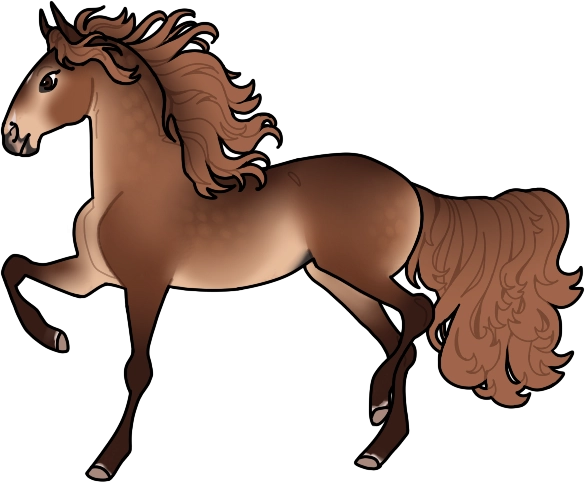
Sooty Pangare Hazelnut + Wulf
Patchwork (Rare)
Category: Oddities
Overview:
- Causes the secondary phenotype to display in the areas where all white markings would be.
- On foals, Patchwork may be anything genetically possible from the parents. In breedings, it is automatically rolled for color.
- On imports, Patchwork is based on the main phenotype. You may remove genes found in the base geno, switch the base color (e/a genes), and add up to 1 natural marking/modifier.
- Rapunzel, carried genes, and oddities are not listed in the Patchwork phenotype.
- Coverage is determined by how much white the horse would have, rather than being subject to normal Chimera rules.
- The base coat will not have white markings, but the Patchwork coat may have white markings and show them that way.
- Affects everything listed under "White Markings" on the Visual Hierarchy page.
- Chimera and Patchwork cannot be on the same horse.
Interactions:
- Oddities* found on the base coat may also show on the Patchwork coat without being in the Patchwork pheno.
- *This excludes Chimera/Patchwork itself - no Patchwork-ception, sorry!
- Marbled: When paired with Patchwork, Marbled will be present around the Patchwork areas as if it were still a white marking.
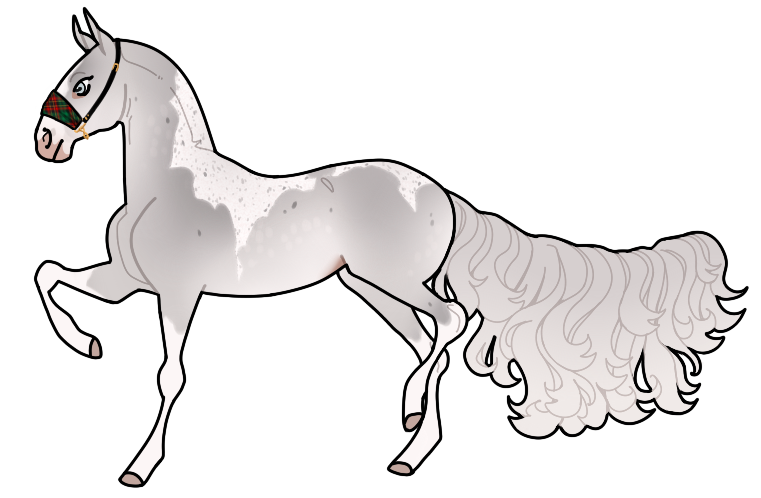
Grey on Lilac Tobiano Rapunzel + Grease Spots, Patchwork (Grey on Lilac Tobiano)
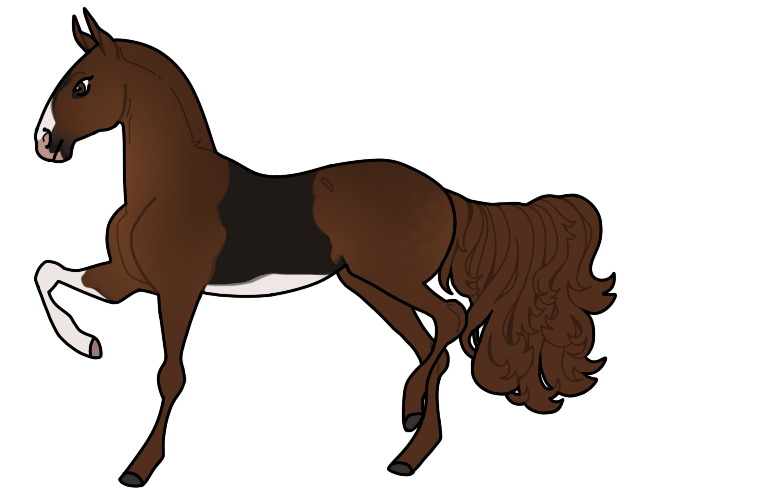
Chestnut Splash Corset + Patchwork (Black Splash)
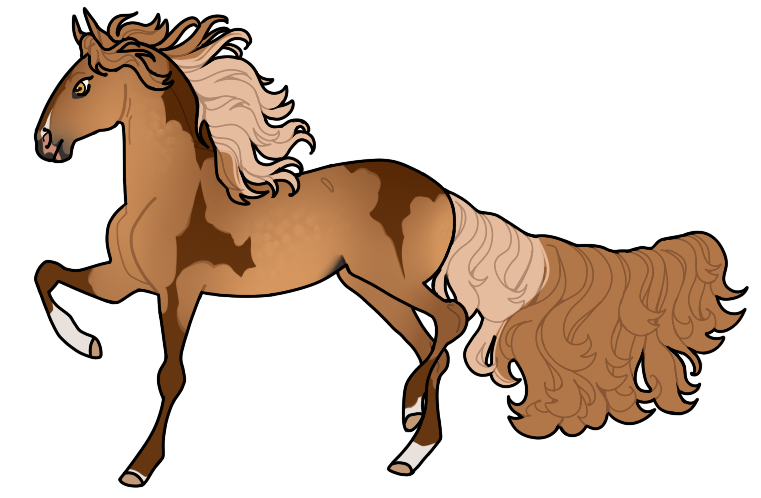
Ginger Tobiano Rapunzel + Wulf, Patchwork (Flaxen Chestnut)
Reaper (Seasonal)
Category: Oddities
Overview:
- Causes the iris and sclera to be pure black (leave eye shine on). Oddly enough, it appears most still have full vision.
- When designing Reaper, please be sure to color the sclera (eye white) layer black as well as the iris itself. The entire eyeball should be fully black.
Interactions:
- Gemstone: When paired with Gemstone, only the sclera (eye white) will turn black, while the iris will be affected by Gemstone.
Cobweb (Seasonal)
Category: Oddities
Overview:
- Spiderweb patterns that appear along the topline of the horse, or in between/in the "corners" of markings.
- Can connect two nearby markings together, or appear independently on the topline
- May be partial if between markings, otherwise should form a full web when viewed from both sides/top.
- May have up to 3 webs total, as long as they do not touch or overlap.
- Mane/Tail: No effect
- Skin: No effect
- Eyes: No effect
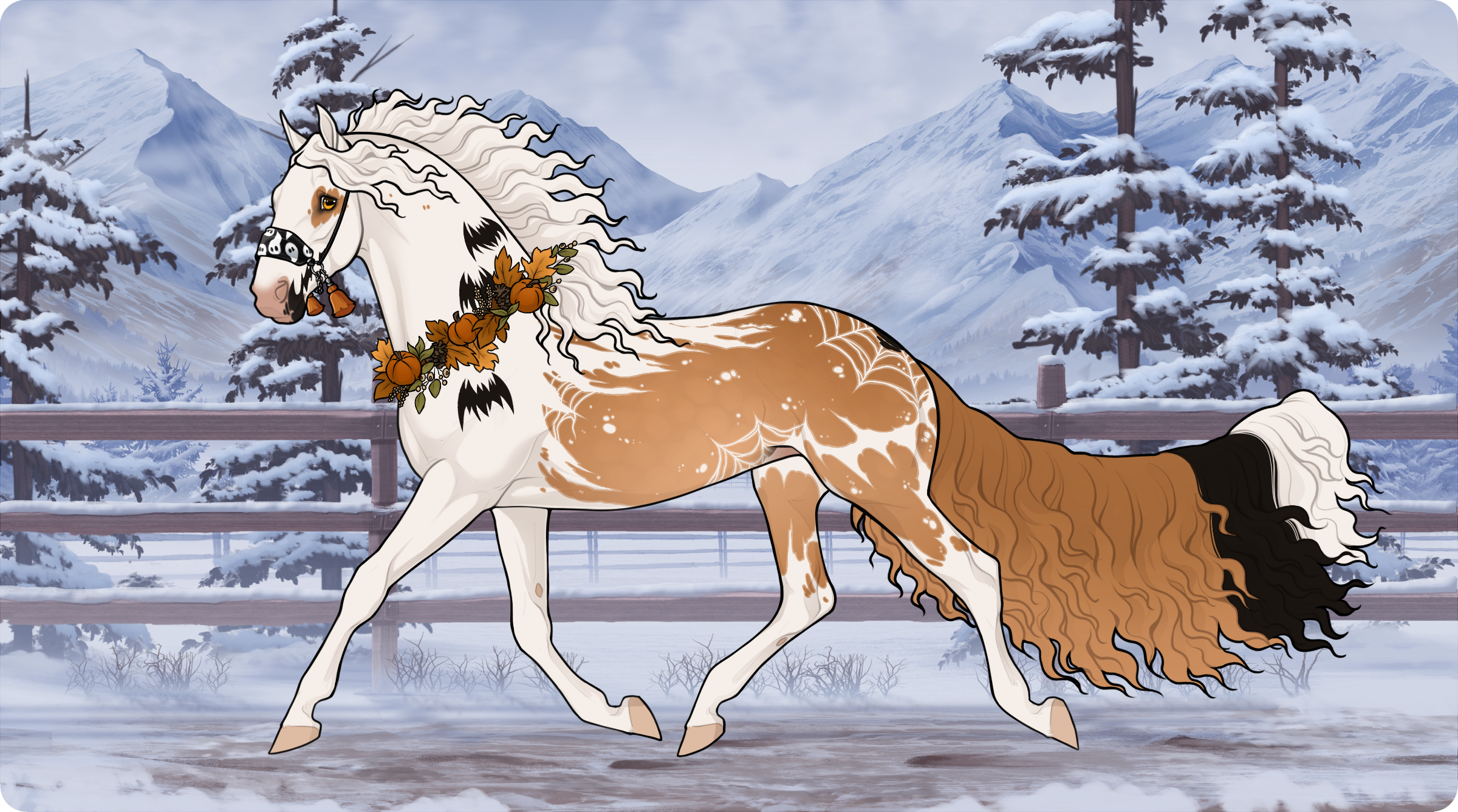
Sooty Ginger Tuxedo Tobiano Sabino Overo Snowflake Appaloosa Ghoul Rapunzel + Gemstone, Cobweb, Wulf, Chimera (Black Tuxedo Ghoul)
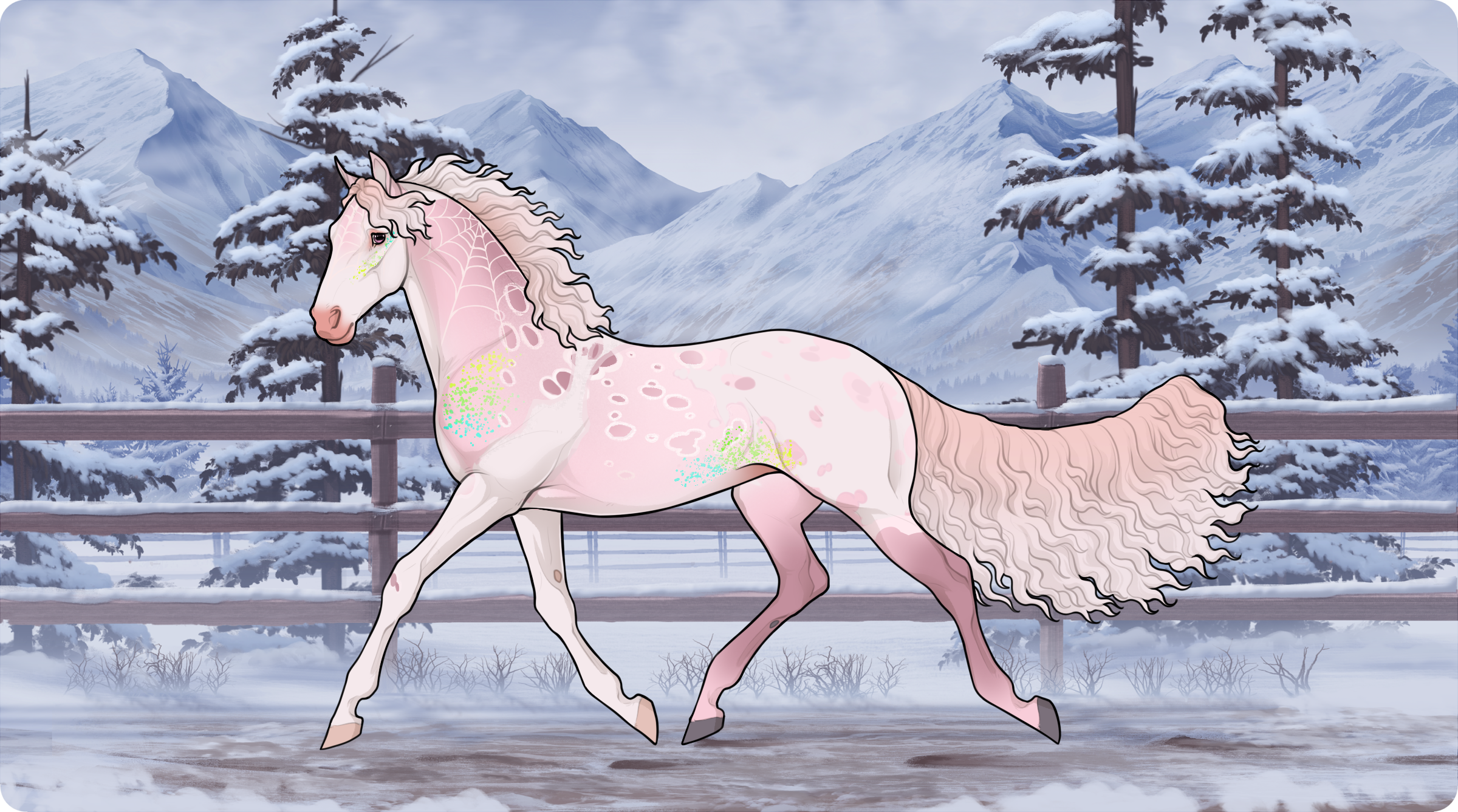
Grey on Dawn Husky Tobiano Blanket Appaloosa Rapunzel + Cobweb, Wulf, Glittered
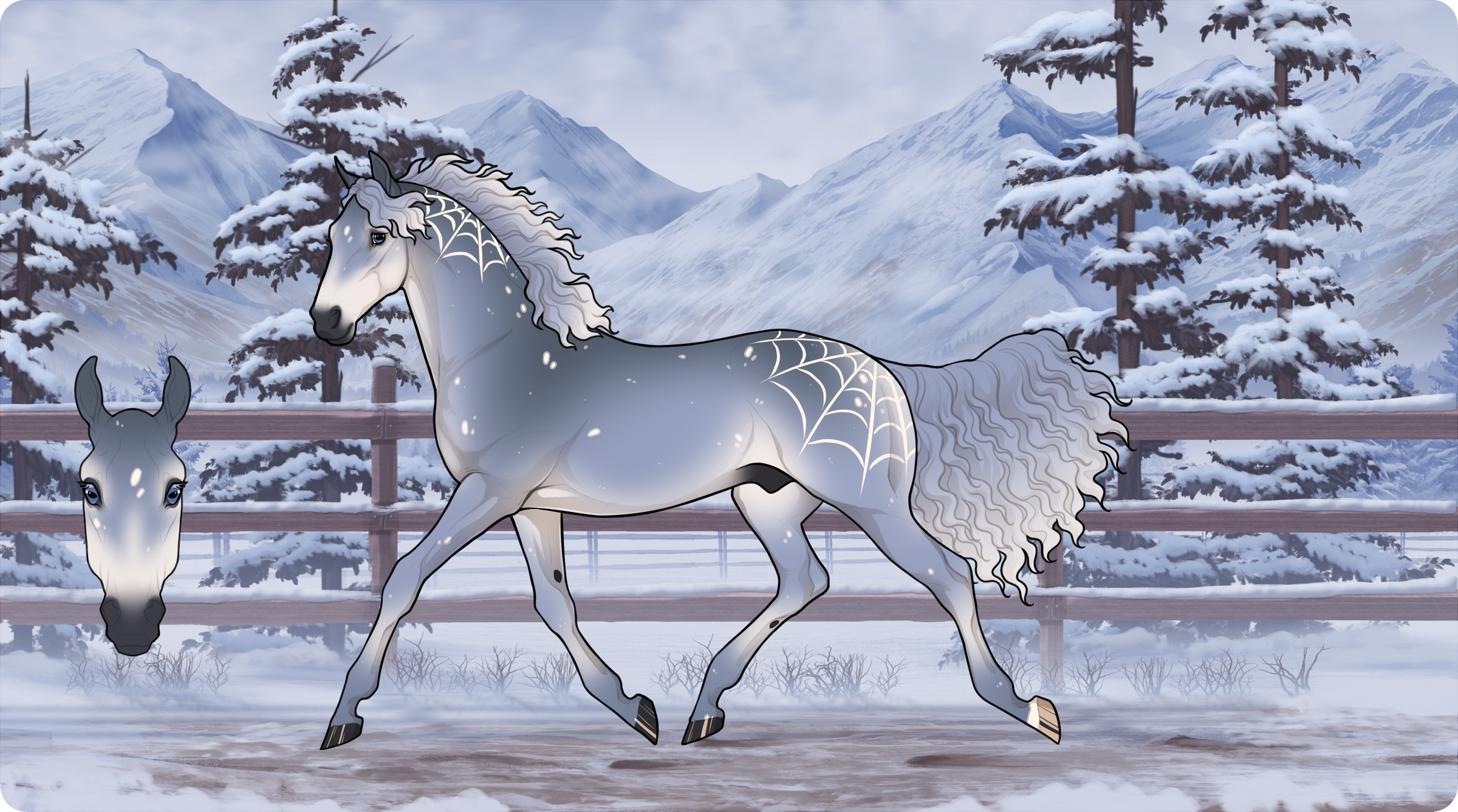
Grey on Blueberry Husky Snowflake Appaloosa (Carries Rapunzel) + Cobweb, Wulf
Phantom (Seasonal)
Category: Oddities
Overview:
- Causes light skeletal markings on the body, head, and legs.
- Skeleton does not necessarily need to be anatomically correct, but should be at least believable (no random ribcages on the neck, please!).
- Should only be a few shades lighter than the coat beneath, with blended/blurred edges.
- May exhibit slight lightening beneath the markings as well (must be blended out, not just a halo around the bones).
- Mane/Tail: No effect
- Skin: No effect
- Eyes: No effect
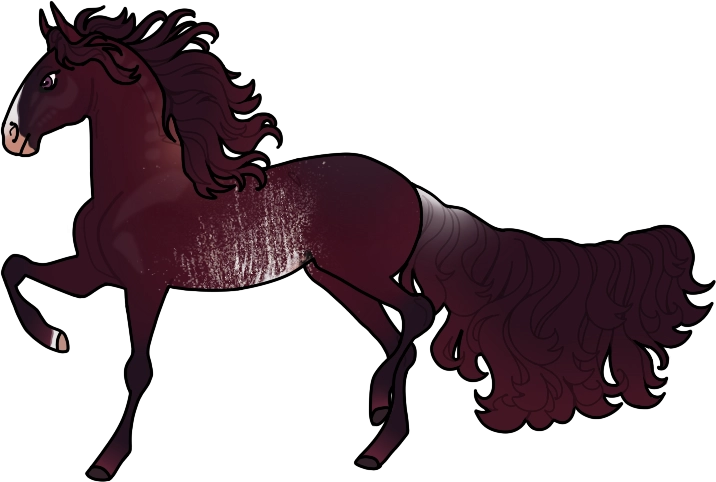
Malbec Rabicano Rapunzel + Wulf, Masked, Phantom
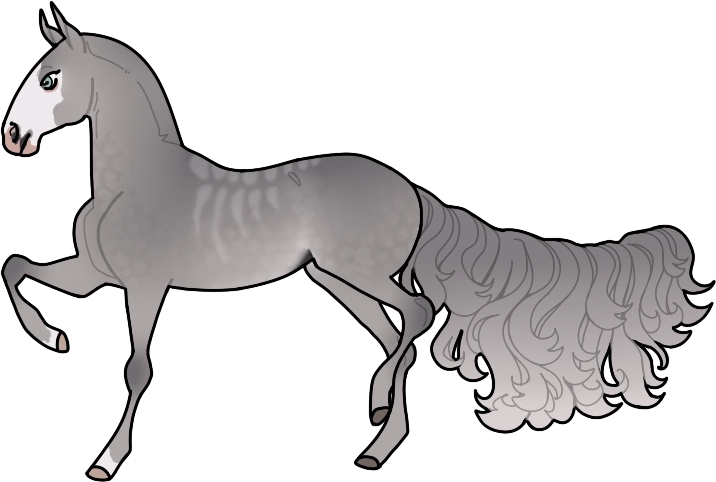
Grey on Slate Overo Rapunzel + Phantom

Silver Malbec Roan Tobiano Rapunzel + Gemstone, Phantom
Glittered (Seasonal)
Category: Oddities
Overview:
- Causes small, colorful, freckle-like spots to cluster along the curves of the body.
- Spots must be visibly colored, not greyscale, and may contain up to three different colors at most.
- Requires spots to be individually distinct (no patches), same opacity, and have a clear area of concentration.
- Should not be strewn randomly across the body, perfectly evenly spaced, all exactly the same size, or extremely sparse.
- Glittered should be most dense along the curve, and have some stray spots spreading from there to create a density gradient.
- Clusters should create an elongated curved shape, not a circle, swirl, or other design.
- Mane/Tail: No effect
- Skin: No effect
- Eyes: No effect
Acceptable Range/Areas:
- Chart below shows acceptable areas of effect.
- The lines drawn are intended to give a vague idea of the flow/shape, but are not precise limits.
- Clusters should not be in other areas (i.e. legs), but can vary a bit within the general areas given.

Range:
- Minimum:
- One small cluster of spots in any acceptable area.
- There should be enough spots to clearly indicate a clustered area of effect, not just one or two random spots.
- Maximum:
- One cluster of spots on the head and two clusters of spots on the body.
- Body clusters may join two areas together if adjacent, but shouldn't branch across the whole body.

Liver Chestnut + Glittered
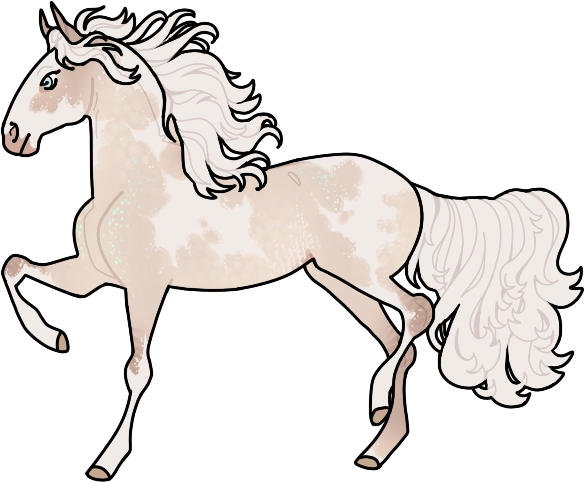
Silver Smoky Cream Dun Tobiano Overo Rabicano Snowfall (Carries Rapunzel) + Wulf, Glittered

Blotted Pangare Buttermilk Buckskin Tobiano + Glittered
Gingerbread (Seasonal)
Category: Oddities
Overview:
- Causes a white stripe that follows the shape of a smooth-edged marking, similar to gingerbread cookie icing.
- Interacts only with natural white, Tobiano, Splash, Corset, Hooded, Tuxedo, and Dutch Lapin. Will not interact with jagged or textured markings; if applicable genes are altered by other genes that make them more irregular/textured, Gingerbread will not act on them.
- May affect some or all of the applicable markings, but must follow a given edge all the way around rather than stopping/tapering halfway.
- Width may vary slightly, generally being thicker on larger markings. Should not be thicker than the marking it borders.
- Should stay reasonably the same in terms of distance and width all the way around, following the shape closely.
- May only be fully hidden if the horse has no applicable markings. If it has any applicable marking, it must border at least one.
- Mane/Tail: No effect
- Skin: No effect
- Eyes: No effect

Grey on Stained Sooty Glacier Tuxedo Splash Rapunzel + Chimera (Dawn), Glittered, Gingerbread
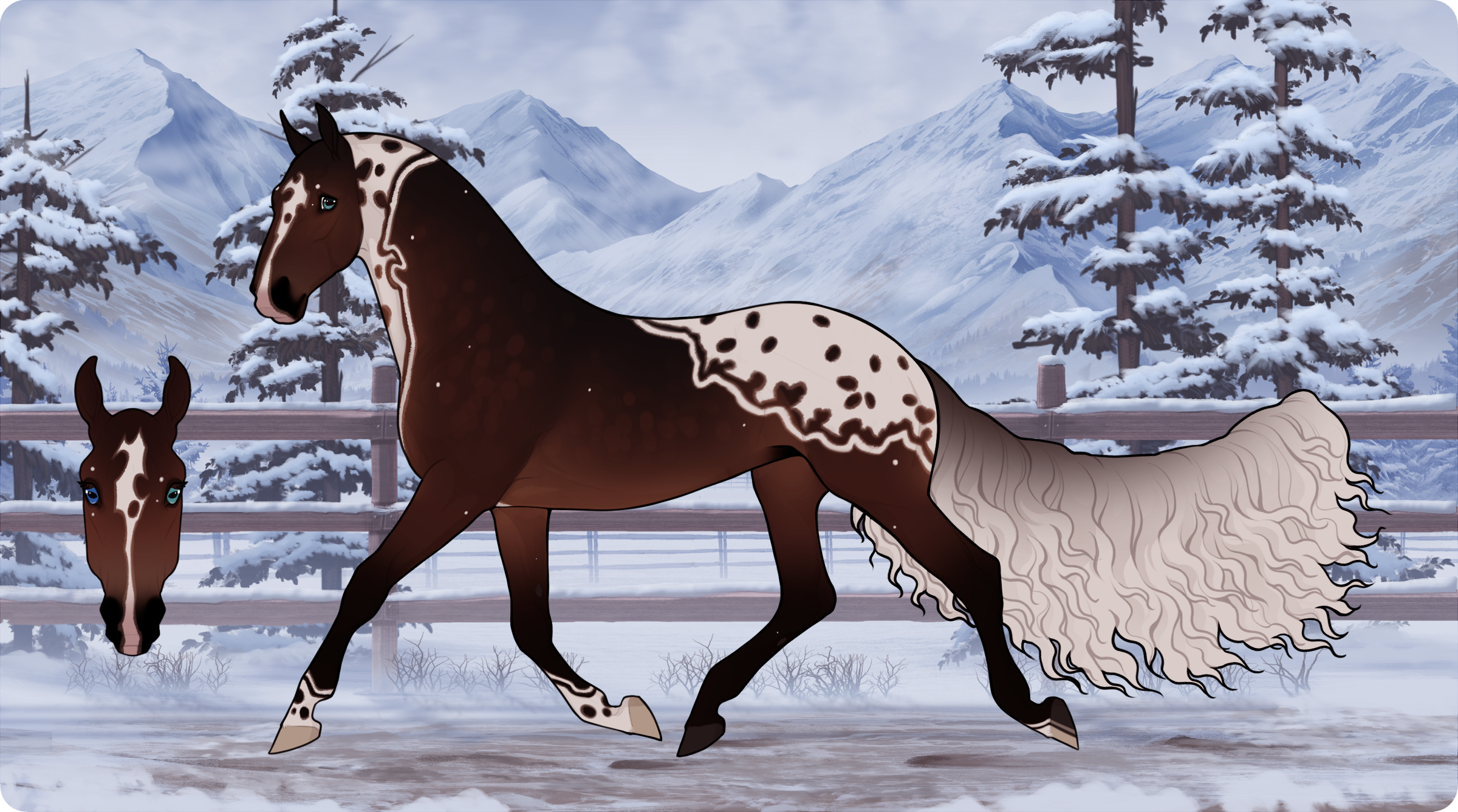
Blotted Silver Sooty Bay Tuxedo Snowcap Appaloosa Rapunzel + Birdcatcher Spots, Gingerbread, Gemstone

Ginger Tobiano Splash Rapunzel + Gingerbread
107 results found.