Design Guide
Fawn (Uncommon)
Genetics: Fwn_
Locus: Fwn
Overview:
- Inspired by fawn markings, this gene causes oval-shaped spots to appear along the topline of the horse.
- Spotting should follow the curve of the body in a linear fashion, arranged in distinct rows instead of randomly interspersed.
- Spots vary in size but will be about the same size on each row, and will get smaller the lower they are on the body. Should not get much bigger than the eye. A few spots may merge/bump into each other, but will not create long lines, and most should stay separate.
- Optionally, pangare-like lightening may cover the belly and a half-heart shaped area on the hindquarters. If those areas are lightened, it may also lighten some or all of these areas - coronets, eyes, muzzle, throat/neck - but cannot do so without the first two.
- Mane/Tail: May slightly lighten up to 1/2 of the tail, starting at tips
- Skin: No effect
- Eyes: No effect
Interactions:
- Spots may be affected by Patchwork, Inverse, and Stained.
Range:
- Minimum: At least two rows of spots, covering either the neck or the hindquarters (hip to dock).
- Maximum:
- Spots cover the whole area from poll to dock, with the largest number of rows on the shoulder and hindquarter areas.
- Neck and barrel should have less rows, so that spots do not extend all the way to the underside.
- Spots should stop at the belly line, not go on to the legs.
- Lightening in the areas described in the Overview.

Buckskin Fawn Rapunzel + Wulf

Sooty Palomino Plum Dun Fawn Tobiano Rapunzel + Gemstone
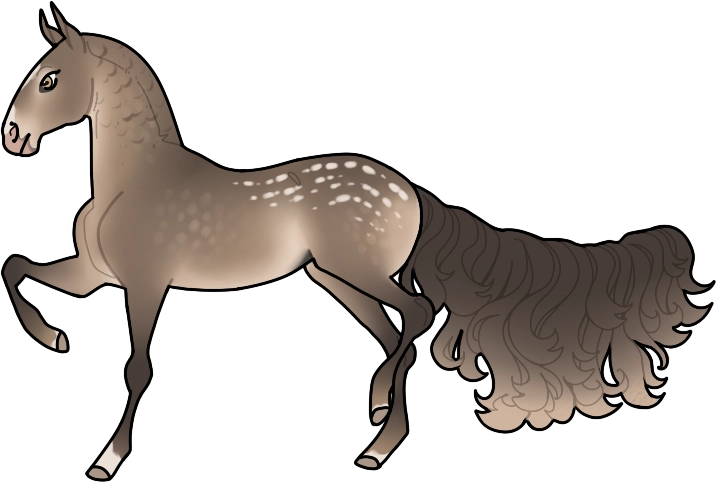
Pangare Spice Fawn Rapunzel + Plumage
Lapin (Uncommon)
⭐ There are three distinct variations of Lapin (see below). Please choose one when designing and edit the phenotype accordingly!
Genetics: Lap_
Locus: Lap
English Lapin
(default - not required to edit pheno unless desired)
Overview:
- White marking that colors most of the horse, leaving the topline, eyes, and muzzle unaffected with optional body spotting.
- Dorsal stripe and markings should not be perfectly smooth; should have slightly rounded cutouts into the white.
- Body spotting should follow the body in a wave/curve, and may start at withers or hocks (can trail off or cover full area).
- Many English Lapin horses display a "beauty spot" beneath the eye, but this is optional.
- Some clustered spotting may also be present at the withers.
- Min/Max is a bit hard to define since the features can be mixed and matched a bit (bigger/smaller muzzle marking, more/less/no spots, etc).
- Mane/Tail:
- Forelock may be white if there is no pigment between the ears.
- Otherwise unaffected (left colored normally).
- Skin: Pink where covering
- Eyes: No effect
Interactions:
- May interact with Patchwork, Inverse, Blotted, Halo, and Stained.
Range:
- Minimum:
- Colored dorsal stripe extends from the poll (between ears) to the dock (start of tail).
- Muzzle is left pigmented, fully covering the nostrils, lips, and chin. Around eye is also left pigmented.
- Spots present from withers to hocks, plus one "beauty spot" under each eye.
- Maximum:
- Colored dorsal stripe extends from just behind the poll (between ears) to the dock (start of tail).
- Muzzle is left pigmented, mostly covering the nostrils, lips, and chin (may end slightly early). Underneath eye is also left pigmented.

Grey on Blueberry Lapin + Rift, Wulf
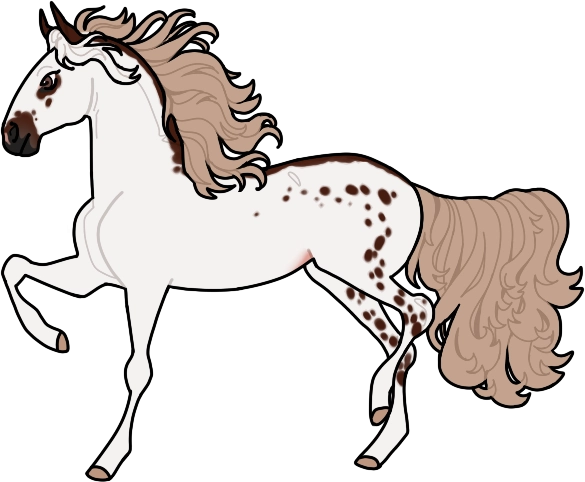
Flaxen Liver Chestnut Lapin + Wulf
Dutch Lapin
(required to edit pheno if chosen)
Overview:
- White marking that covers the neck and shoulder, with optional head markings.
- Face marking originates from a snip on the nose and bleeds up/outward. Cannot have other facial white if this is present.
- Markings should be fairly smooth at the edges, sloped inward rather than bulging outward.
- Mane/Tail:
- Mane solid white where touching
- No effect on tail (does not reach)
- Skin: Pink where covering
- Eyes: No effect
Interactions:
- May interact with Patchwork, Inverse, Blotted, Halo, and Stained.
Range:
- Minimum:
- White at least 2/3 up the neck.
- White from middle of withers to armpit.
- Maximum:
- White all the way up to throat and behind the ears.
- White from end of withers to the same vertical point on the belly.
- Face Marking: Starts at top of forehead and ends at the front edge of the cheek, wrapping in front of the eyes (not covering).

Silver Blueberry Dutch Lapin Rapunzel Orchid + Vitiligo

Sooty Pangare Liver Chestnut Splash Dutch Lapin Rapunzel
Cali Lapin
(required to edit pheno if chosen)
Overview:
- White marking that covers the majority of the body, leaving extreme areas of the face and legs alone.
- May leave the knees/hocks alone, or leave the pasterns alone, but not neither/both/combo.
- Markings should have rounded cutouts into the white rather than being perfectly smooth, but shouldn't be spotty/jagged.
- Mane/Tail:
- Mane may be solid white, normal colored, or have a colored forelock if pigmented between the ears.
- No effect on tail (always left colored normally).
- Skin: Pink where covering
- Eyes: No effect
Interactions:
- May interact with Patchwork, Inverse, Blotted, Halo, and Stained.
Range:
- Minimum:
- Color left on the ears, as well as the poll to bridge the space between them.
- Color on the nose/muzzle, fully encompassing nostrils/lips/chin and spiking upward to the start of the eyes.
- Color on the knees/hocks OR the pasterns (not both, neither, or a combination).
- Maximum:
- Color left on the ears only, but not the poll.
- Color in a snip shape on the nose, at least as large as the nostril.
- Color on the knees/hocks OR the pasterns (not both, neither, or a combination).

Blue Roan Cali Lapin + Chimera (Blue Roan)
Sooty Black Pearl Plum Cali Lapin (Carries Rapunzel) + Gemstone, Rift
Tabby (Uncommon)
Genetics: Ty_
Locus: B | Ty | Cv | Dt | D
BTy = Bengal, TyCv = Tabby, TyDt = Tabby, TyD = Dun Tabby, nTty/TyTy = Tabby
Overview:
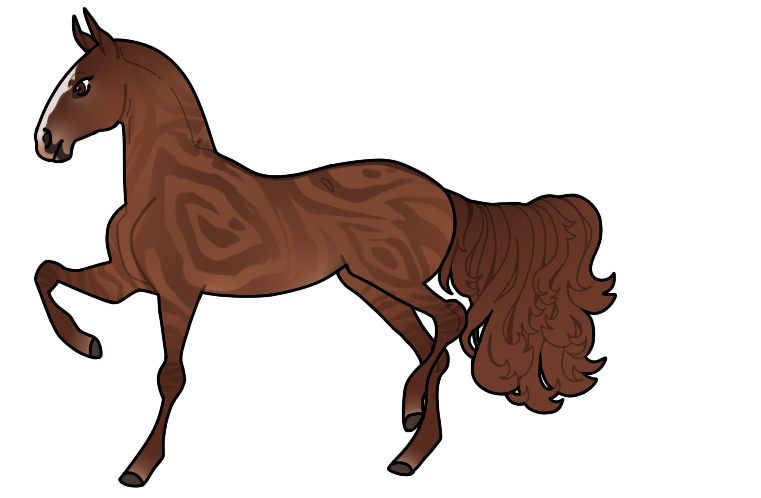
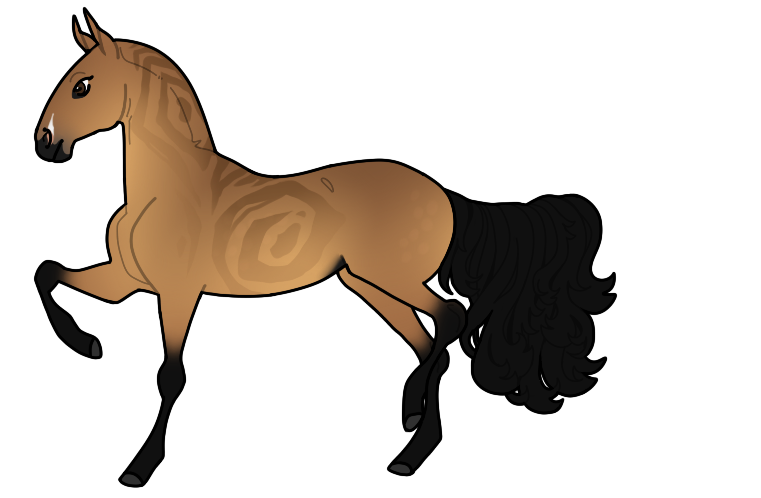
- Causes swirl/stripe markings that mirror the appearance of classic tabby cats, causing a combination of swirls around 1-3 origin points on the body and stripes that follow the flow/shape of the body.
- Stripes should generally be oriented horizontally on most of the body, but may become more vertical in the neck/withers area.
- Markings are always darker than what's below them, but can be lowered in opacity as to be affected by natural variance.
- Where they cross the undersides or at the edge of partial-body coverage, stripes may optionally be faded by a soft gradient, either to lower their opacity or fade them out completely.
- Ends of the stripes should taper, and width of stripes should vary. Origin point of the swirled markings may be more solid/rounded.
- Face markings are optional on the cheek/jaw and forehead areas, often with the classic M-shaped mark above the eyes like tabby cats.
- Mane/Tail: Neck stripes may continue into the mane if they cross over the crest. Tail may be striped, following the direction of the hair. Both mane and tail stripes may be solid from root to tip or fade out at the ends.
- Skin: No effect
- Eyes: No effect
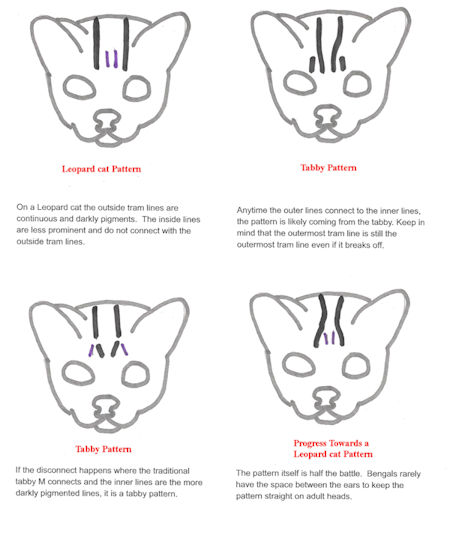
Interactions:
- Dun Tabby: When Dun and Tabby are present on the same horse, both will co-exist.
- Causes body dilution under the Tabby markings.
- Also causes dorsal stripe and leg barring, but not shoulder barring.
- Dorsal stripe will be on top if darker than Tabby, or underneath if lighter.
- Leg barring should show one or the other on the joint, not overlap.
- Facial cobwebbing from Dun is optional but should not cross/overlap Tabby face markings.
- Only applies to normal Dun, not Primitive Dun.
Range:
- Minimum: Stripes covering at least half of the main part of the body (excludes head/legs). Must have at least one swirl area.
- Maximum: Stripes covering the entire body, except for the head and lower legs.
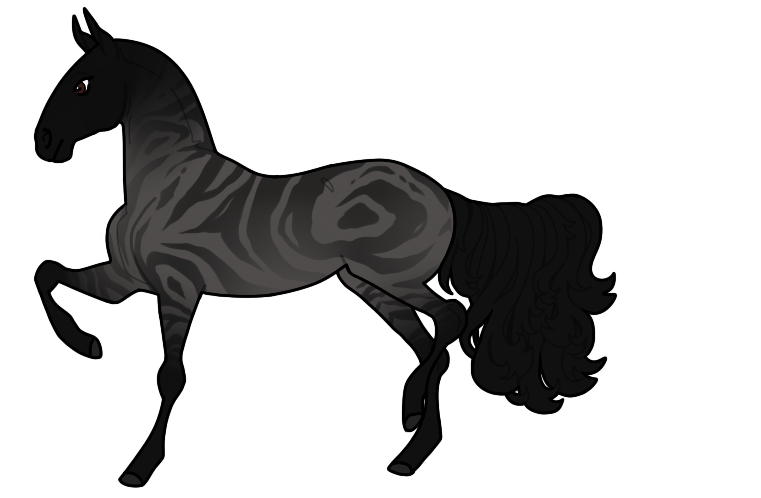
Blue Roan Tabby
Red Dun Tabby
Buckskin Tabby
Inverse (Rare)
Genetics: invinv*
*Must be invinv to show; otherwise carried
Locus: inv
Overview:
- Inverts the white markings on a horse, making it white where it would otherwise be colored, and vice-versa.
- Affects everything listed under "White Markings" on the Visual Hierarchy page, except for natural white.
- Natural white is only affected when caused by minimum requirements (i.e. Tobiano socks) or accompanied by additional markings.
- For example, it will not invert a horse with only a natural white sock, but will invert a horse with a coronet marking and a patch of Overo on the body.
- Natural white markings may be added back on top of the design after inverting if desired.
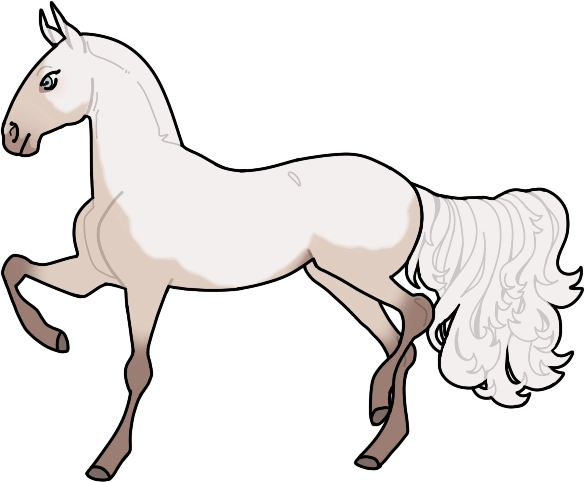
Inverse Perlino Splash

Inverse Chestnut Tobiano

Inverse Black Dutch Lapin
Civet (Rare)
Genetics: Cv_
Locus: B | Ty | Cv | Dt | D
BCv = Bengal, TyCv = Tabby, CvDt = Civet, CvD = Dun Civet, nCv/CvCv = Civet
Overview:
- Civet causes broken/spotted striping that flows horizontally across the body. Stripes should be fairly large and rounded rather than thin and sharp.
- It is at its most random in the center of the barrel, though its striping pattern is much more clearly defined on the hindquarters and chest.
- Overall, even where it is most spotted, Civet should have a relatively linear flow instead of being completely scattered.
- Causes a dorsal stripe that extends from tail to poll, and solid legs up to at least above the knee/hock.
- May optionally cause a dark mask on the face that extends over the eyes. May be a solid mask or cause spotting/striping below the eye.
- Striping/spotting must be darker than what is below it. The edges of a group of stripes may be faded (for example, on the upper neck if extensive coverage, or at the ends of a group of chest stripes).
- Mane/Tail: No effect
- Skin: No effect
- Eyes: No effect
Interactions:
- Dun Civet: When Dun and Civet are present on the same horse, both will co-exist.
- Causes body dilution under the Civet markings.
- Dorsal stripe and leg barring are not visible as Civet is on top.
- Should not have shoulder barring from Dun.
- Only applies to normal Dun, not Primitive Dun.
Range:
- Minimum:
- Solid legs extending just above the knee/hock, horizontal broken striping up to the chest and back of the legs/hindquarters.
- Striping should come at least halfway up to the chest, and at least up to the stomach line in the back.
- Dorsal stripe from tail to poll.
- Maximum:
- Solid legs extending just above the knee/hock, horizontal broken striping up to the chest and back of the legs/hindquarters.
- Further broken striping across the entirety of the barrel, becoming spottier toward the center.
- May travel halfway up the neck before fading off.
- Dark mask covers the top of the head and wraps around the eyes/cheeks.
- Dorsal stripe from tail to poll.
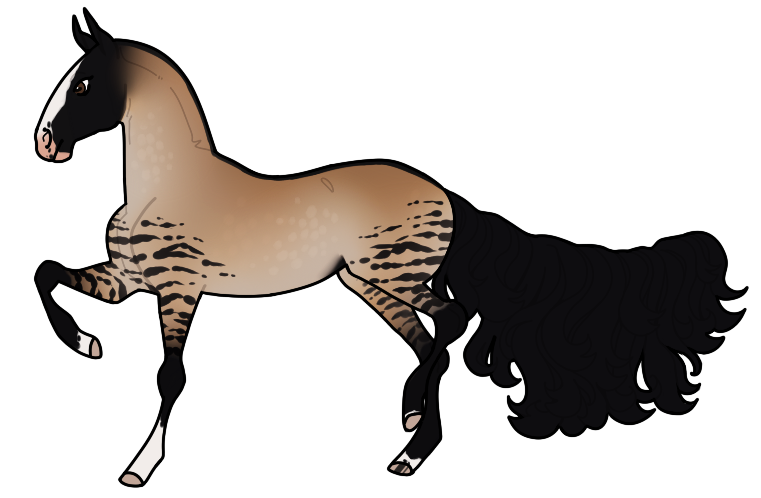 Grey on Buckskin Civet Rapunzel + Masked
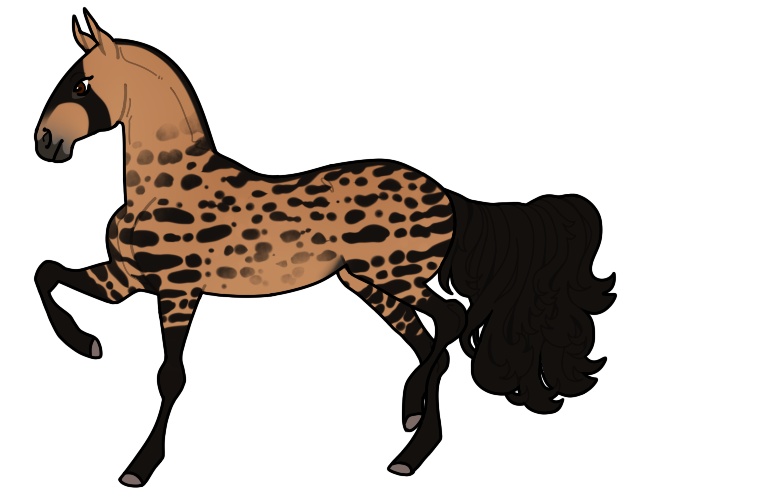 Buckskin Civet
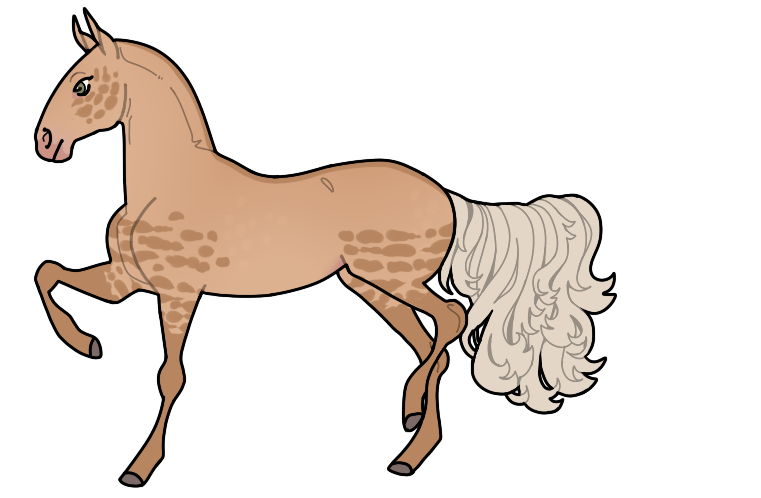 Gold Pearl Civet
Gnarled (Seasonal)
Genetics: Tr_
Locus: Tr
Overview:
- Causes tree/branch-like markings that extend from the legs. May come from one, multiple, or all legs, starting at any point on the leg.
- May vary in size/length/width, but should not cross the topline or touch the head, and should not touch/overlap after branching away.
- Markings should be one solid color and must be darker than any other point on the body.
- Branches should generally follow the shape of the body and should taper at the ends.
- Mane/Tail: No effect
- Skin: No effect
- Eyes: No effect

Blotted Gnarled Pecan Husky Tobiano Rapunzel

Gnarled Blueberry Tabby Husky Harlequin Rapunzel (Carries Flaxen, Plum)
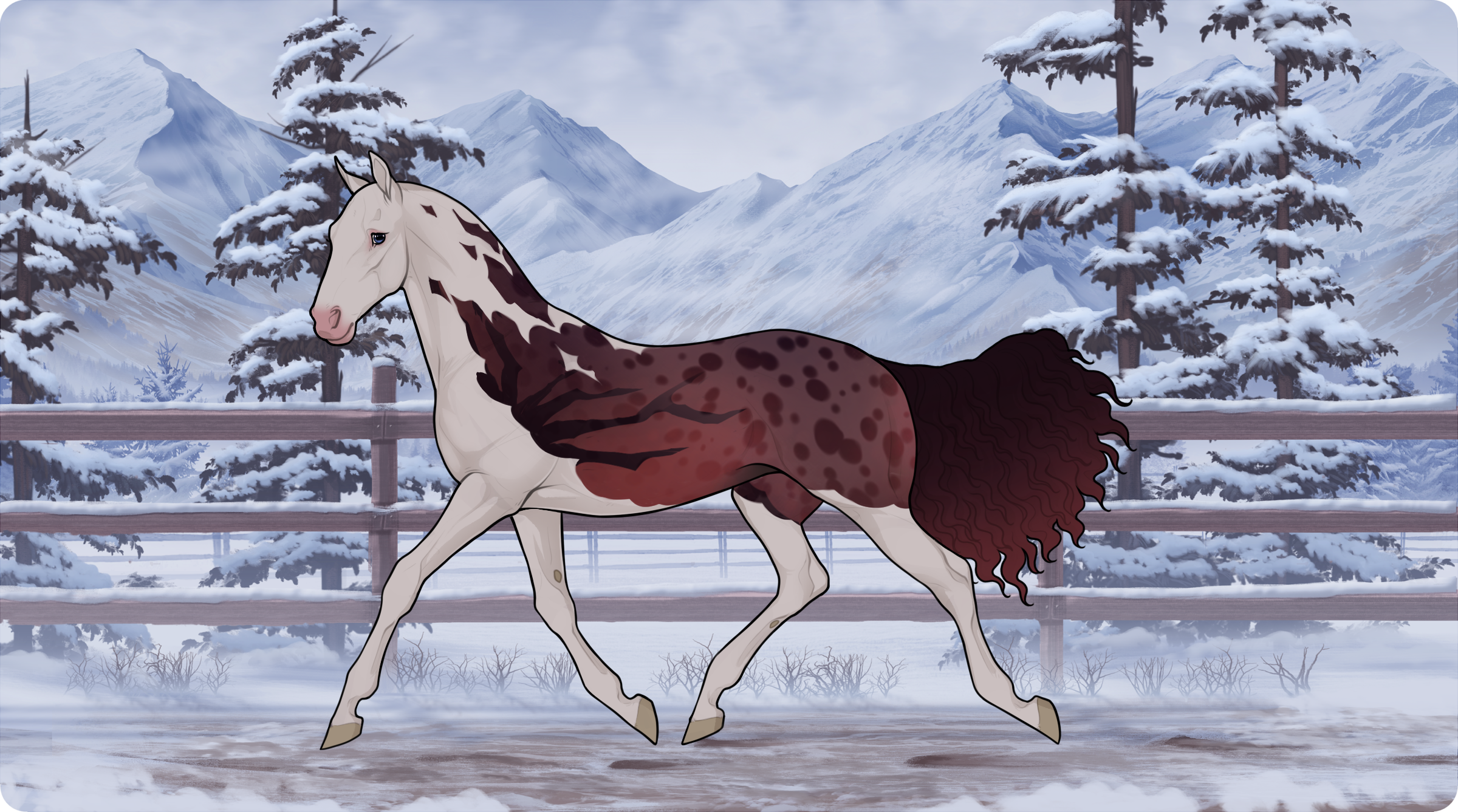
Blotted Gnarled Cherry Roan Splash Ghoul (Carries Rapunzel)
Ghoul (Seasonal)
Genetics: Gh_
Locus: Gh
Overview:
- White pattern that originates from the head/neck, as if a sheet has been draped over the horse.
- May have ripped/torn holes for the eyes, mouth, and within the pattern. Holes should be tapered.
- Edges will be irregular/frayed, again as if torn or cut at the ends.
Range:
- Minimum: Must cover most of the head, covering up to the eye/jaw vertically. Should have the same tapered edges as usual.
- Maximum: Marking should angle up and taper along the back toward the tail, not reaching the tailhead. Cannot cross the belly, and coverage should taper closer to the topline as it moves toward the back of the horse.
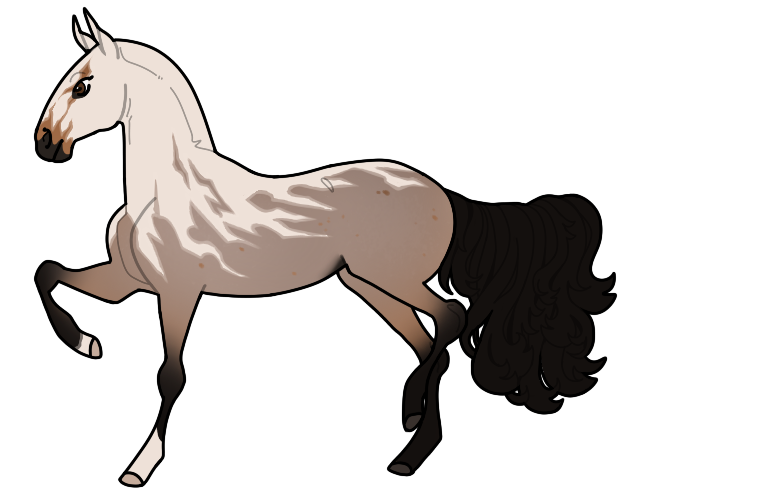
Buckskin Roan Ghoul
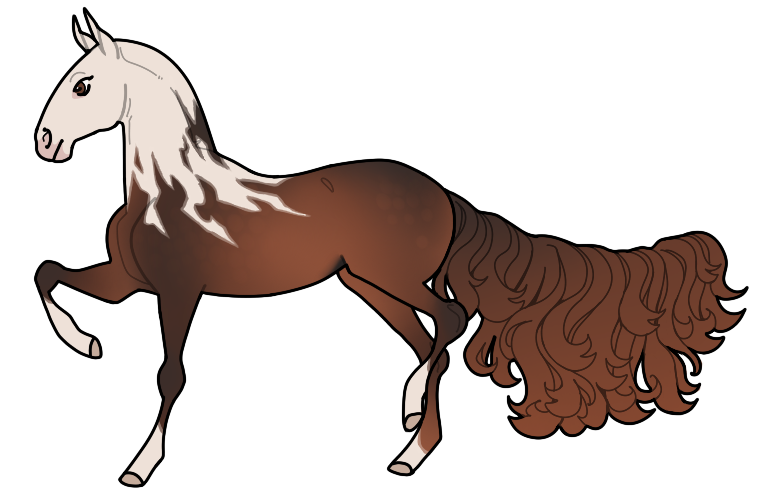
Sooty Chestnut Ghoul Rapunzel
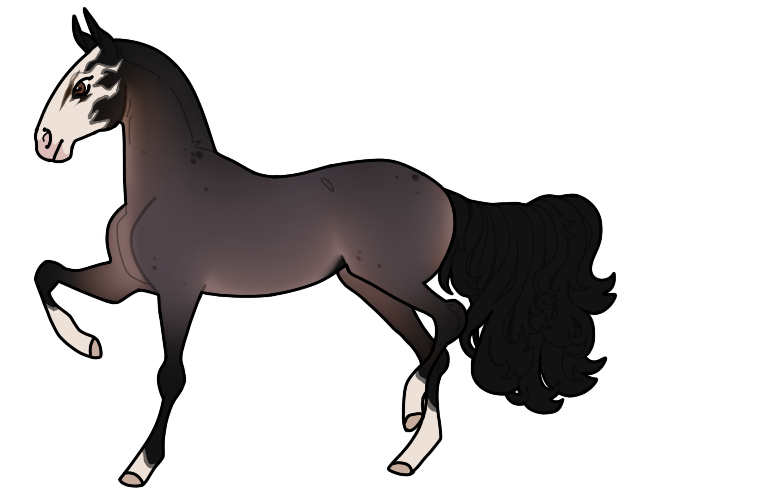
Bay Roan Ghoul
Birdcatcher Spots (Common)
Overview:
- Presents as small white spots dispersed around the body.
- Should be small and sparse, not to exceed approximately the size of the pupil.
- Mane/Tail: No effect
- Skin: No effect
- Eyes: No effect

Primitive Smoky Grullo + Gemstone, Birdcatcher Spots

Sooty Primitive Grullo Tuxedo + Wulf, Gemstone, Birdcatcher Spots
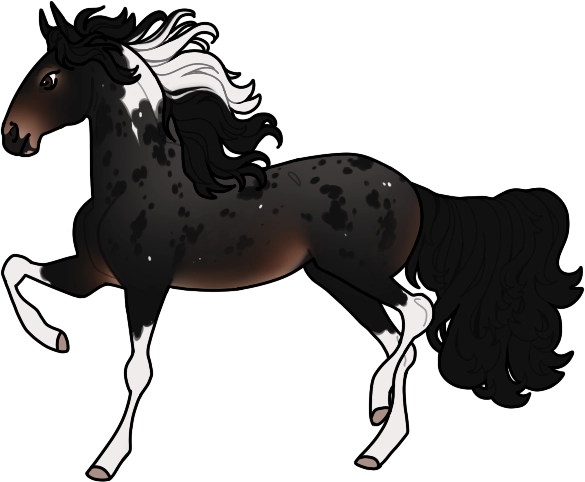
Pangare Seal Bay Merle Roan Tobiano + Wulf, Birdcatcher Spots
Grease Spots (Common)
Overview:
- Creates dark spots dispersed throughout the coat, roughly the size of the eye or smaller.
- Should be a few shades darker than the coat beneath.
- Mane/Tail: No effect
- Skin: No effect
- Eyes: No effect

Bay Roan + Grease Spots
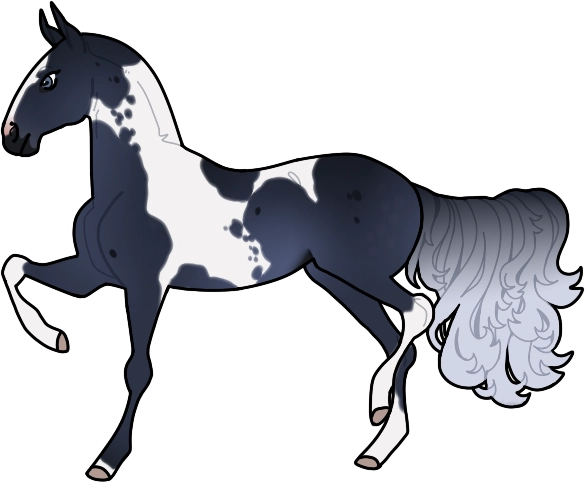
Silver Blueberry Tobiano + Grease Spots
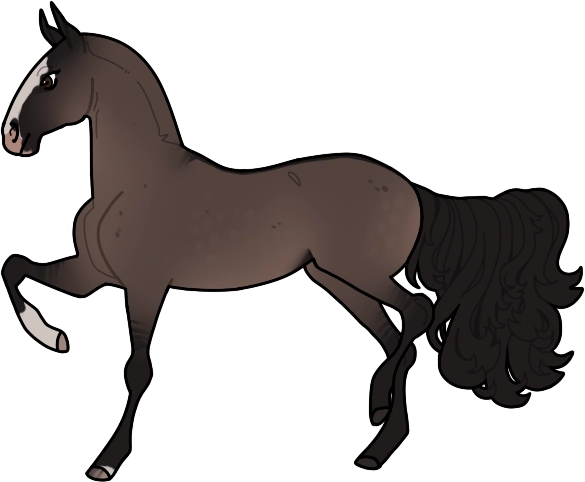
Grullo + Grease Spots
Flecked (Common)
Overview:
- Causes small, dark freckle-like spots to cluster along the curves of the body.
- Spots should be a few shades darker than the coat beneath, but not overly dark.
- Requires spots to be individually distinct (no patches), same opacity, and have a clear area of concentration.
- Should not be strewn randomly across the body, perfectly evenly spaced, all exactly the same size, or extremely sparse.
- Flecked should be most dense along the curve, and have some stray spots spreading from there to create a density gradient.
- Clusters should create an elongated curved shape, not a circle, swirl, or other design.
- Mane/Tail: No effect
- Skin: No effect
- Eyes: No effect
Acceptable Range/Areas:
- Chart below shows acceptable areas of effect.
- The lines drawn are intended to give a vague idea of the flow/shape, but are not precise limits.
- Clusters should not be in other areas (i.e. legs), but can vary a bit within the areas given.

Range:
- Minimum:
- One small cluster of spots in any acceptable area.
- There should be enough spots to clearly indicate a clustered area of effect, not just one or two random spots.
- Maximum:
- One cluster of spots on the head and two clusters of spots on the body.
- Body clusters may join two areas together if adjacent, but shouldn't branch across the whole body.
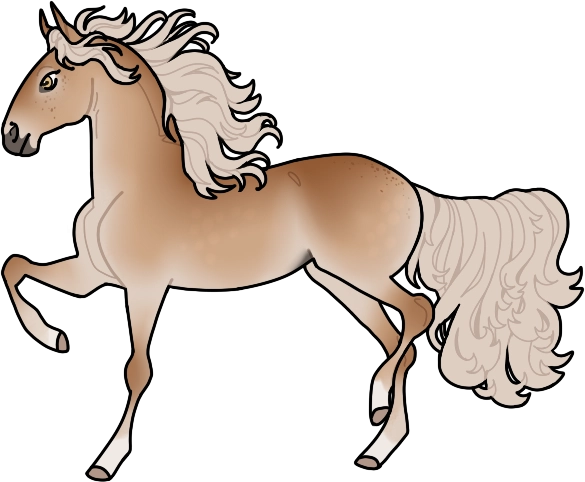
Flaxen Pangare Flame + Wulf, Flecked
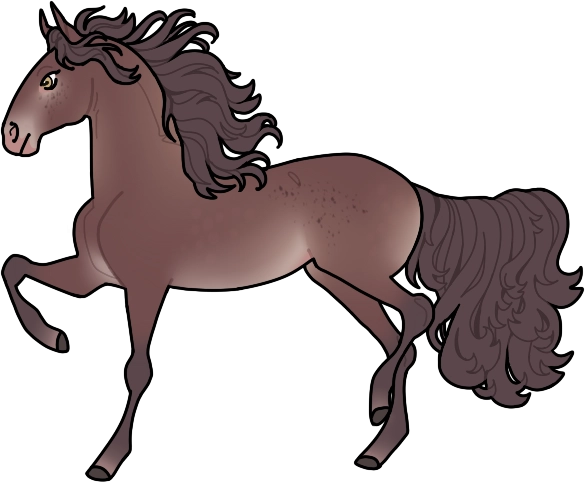
Pangare Amber Champagne Plum + Flecked, Wulf
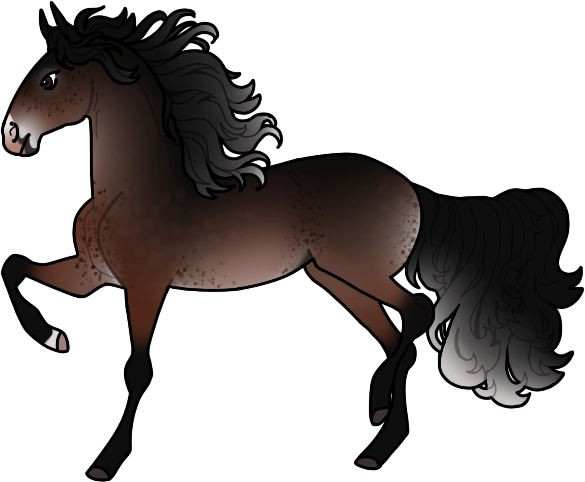
Grey on Sooty Bay + Flecked, Wulf
Halo (Common)
Overview:
- Causes markings to partially "fail," producing an extended mapping effect (low-opacity white around the marking).
- Mapping should represent a correct placement of the marking, but with solid white not fully coming out to the edges.
- Halo may affect some or all of the markings, including natural white, but should still leave a significant amount of solid white in each area (i.e. no areas that are fully just low-opacity / mapping).
- Mane/Tail: No effect
- Skin: No effect
- Eyes: No effect
Interactions:
- Halo interacts with Patchwork to cause low-opacity mapping that shows the Patchwork coat rather than being low-opacity white.
- When paired with Marbled, all Halo mapping will become dark instead of low-opacity.

Sooty Bay Roan Tobiano + Halo, Grease Spots
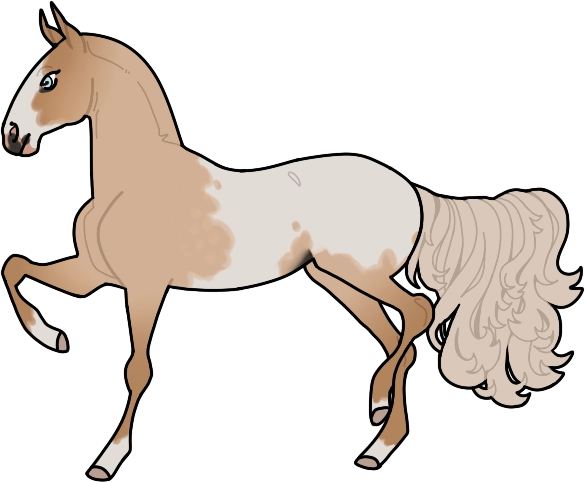
Palomino Roan Overo Snowcap + Halo
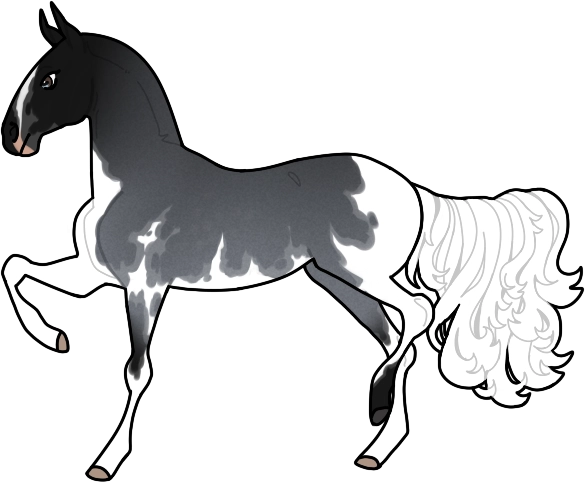
Blue Roan Sabino Splash + Halo
Gemstone (Common)
Overview:
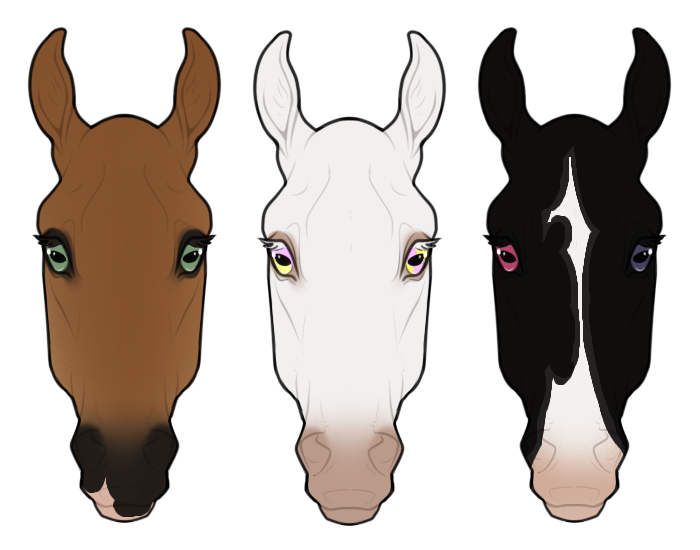
- Causes the eyes to be any non-greyscale color. They must have a noticeable hue, and cannot contain more than two colors.
- Bicolored gemstone presents like Heterochromia but doesn't have to be blue; first color goes on as normal, then a second color may fully color an eye and/or cause patches in one or both.
Interactions:
- Rift: When paired with Rift, the eye color must be light/pale, with a typical blind pupil for Rift.
- Reaper: When paired with Reaper, the sclera (eye white) will turn black, while the iris will be affected by Gemstone.
Vitiligo (Common)
Overview:
- Vitiligo causes spotted white pigment that originates from the mouth/nose, eyes, armpit, and groin.
- Spots should be small and numerous, and will be pink in skin areas (nose/mouth/eyes/groin).
- May cause some stray spots on the body as well, but should be very sparse.
- Mane/Tail: No effect
- Skin: Pink where touching.
- Eyes: No effect
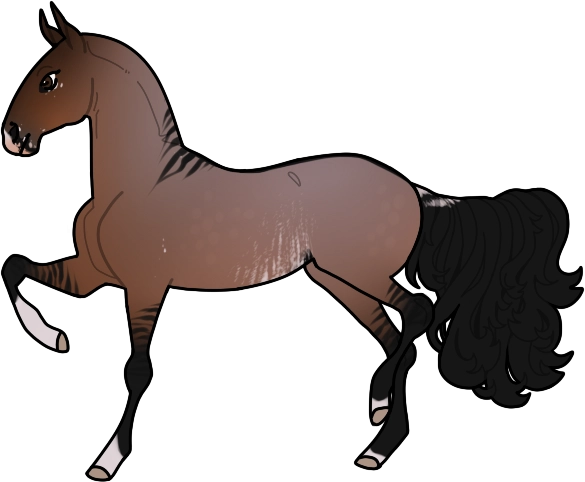
Bay Primitive Dun Roan Rabicano + Vitiligo

Black Corset Splash + Vitiligo
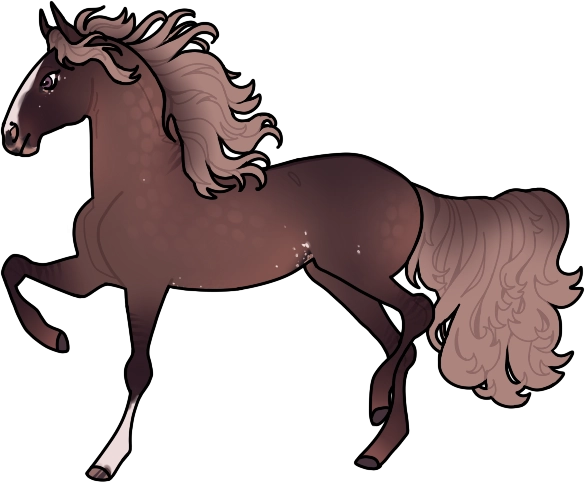
Sooty Flaxen Chestnut Plum Dun + Masked, Vitiligo, Wulf
Masked (Common)
Overview:
- Causes the head to be the same color or slightly darker than the darkest point of the coat.
- Should not be overly dark in comparison to the coat color, and should follow similar levels of saturation.
- Must cover at least the area from poll to eyes, eyes to nostril, and nostril to chin.
- Edges should be blended out, not solid.
- Mane/Tail: No effect
- Skin: No effect
- Eyes: No effect
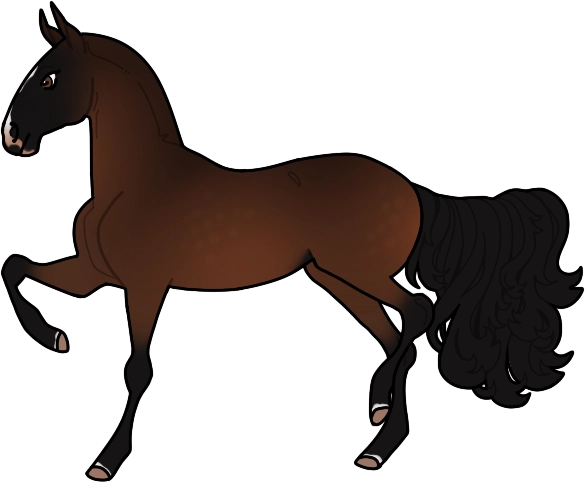
Sooty Bay + Masked
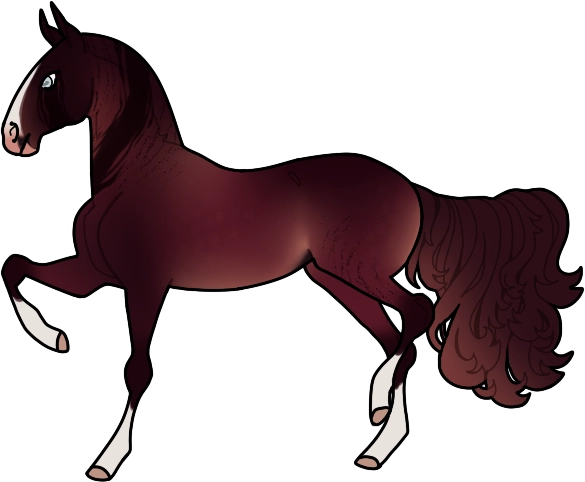
Sooty Pangare Sangria + Masked, Rift, Brindle

Hazelnut Rabicano Sabino (Carries Rapunzel) + Masked, Gemstone, Wulf
Plumage (Common)
Overview:
- Causes the appearance of feathering on the neck.
- Markings may be slightly lighter or slightly darker than the coat below them.
- Should mostly consist of curved/scalloped markings (1-3 "bumps"), but may also have some spots, especially at the top and bottom.
- Must cover most/all of the neck, from behind the ears to the shoulder line. May taper off slightly at the end.
- Mane/Tail: No effect
- Skin: No effect
- Eyes: No effect
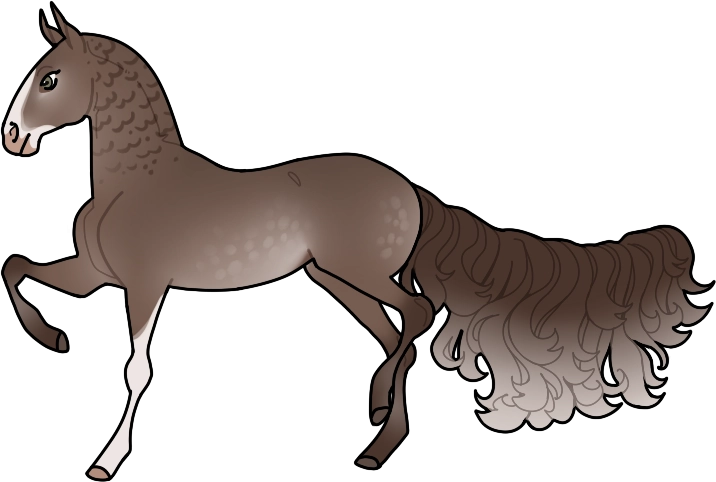
Grey on Black Pearl Splash Rapunzel + Plumage
Pangare Spice Fawn Rapunzel + Plumage

Stained Pangare Black Pearl Tobiano Rapunzel + Wulf, Plumage
Chimera (Uncommon)
Overview:
- Causes patches of another color on the coat, according to the specifications below.
- On foals, Chimera may be anything genetically possible from the parents. In breedings, it is automatically rolled for color.
- On imports, Chimera is based on the main phenotype. You may remove genes found in the base pheno, switch the base color (e/a genes), and add up to 1 natural marking/modifier.
- Rapunzel, oddities, and carried genes are not listed in the Chimera pheno.
- Ranges in size and shape of coverage, but should be no smaller than the hoof and no larger than half of each separate side of the body.
- Each area of coverage should be a distinct patch, not striping/brindling, a geometric/special shape, etc. Edges are somewhat irregular.
- May have up to 3 different patches total. Each should have a main area of concentration, not branch all the way across the body.
- Markings should not line up perfectly at the edges between base coat and Chimera patches. This includes continuous stripes, white markings, etc.
- Chimera and Patchwork cannot exist on the same horse.
- Effect on Mane/Tail:
- Neck patches should continue into the mane.
- If a Chimera patch covers the dock of the tail, the tail must be affected (partial or full coverage).
- If no patch is present at the dock of the tail, up to half of the tail can optionally be affected by Chimera on its own.
Interactions:
- Oddities* found on the base coat may also show on the Chimera coat without being in the Chimera pheno.
- *This excludes Chimera/Patchwork itself. To add an additional layer of Chimera inside the existing Chimera patches, you'll need to use a Tornado item.
Range:
- Minimum: One visible patch at least as large as the hoof.
- Maximum: Three patches on the body and one patch in the tail.
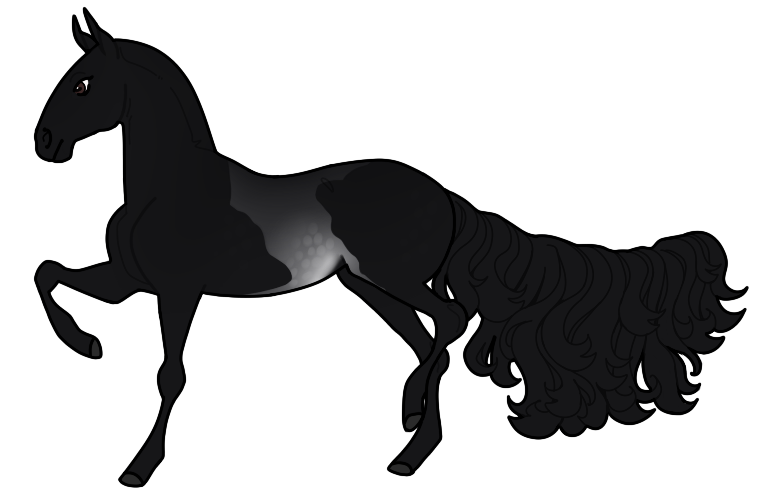
Black Rapunzel + Chimera (Grey on Black)

Latte Tobiano Splash Corset + Wulf, Halo, Chimera (Espresso Tobiano Splash)
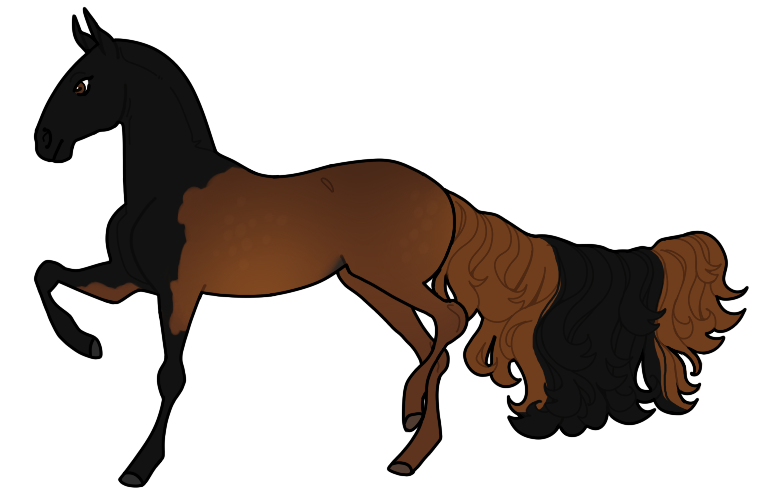
Chestnut Rapunzel + Chimera (Black)
Brindle (Uncommon)
Overview:
- Brindle may be present on some or all of the body.
- Can be darker than the base (normal) or light/white ("Reverse Brindle")
- Stripes should be relatively thin and textured, not to resemble zebra striping, primitive dun/bengal, etc.
- Stripes should follow the flow/curves of the body, not be perfectly straight nor overly curvy/swirled.
- Thickness will vary and ends should taper.
- Mane/Tail: No effect
- Skin: No effect
- Eyes: No effect
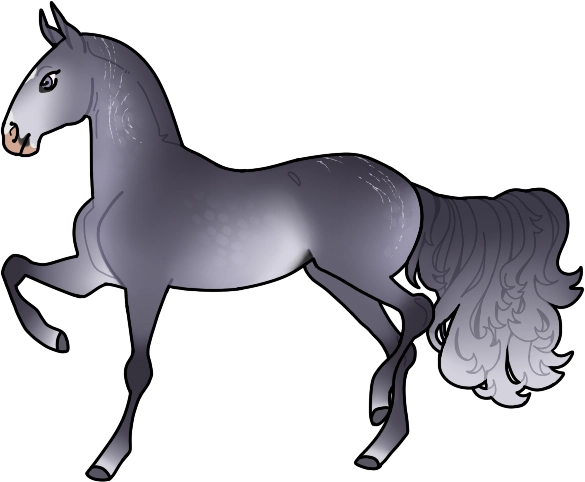
Grey on Onyx + Brindle

Amber Champagne + Brindle
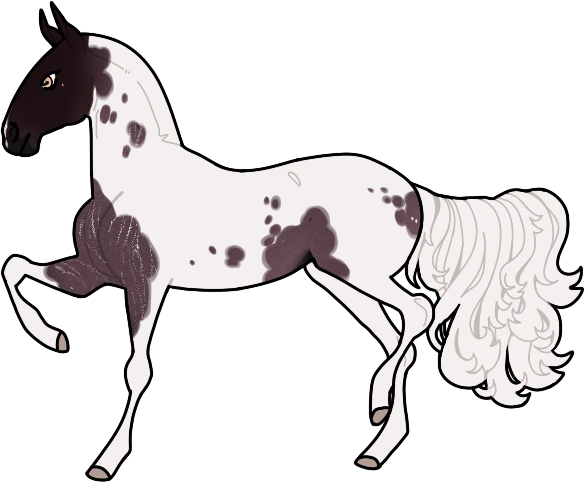
Black Plum Roan Tobiano + Gemstone, Birdcatcher Spots, Brindle
Rift (Uncommon)
Overview:
- Causes a dark marking with striped edges that runs from the topline to the underside.
- Marking shape should be a smooth line from end to end, not be jagged, peaked, or double back on itself.
- Edges of the marking should be striped/brindled, following the flow of the marking and staying close to edge.
- Markings will start and end at the same place on both sides of the horse, and should thus be fairly symmetrical.
- Rift will always be darker than the darkest point of the base coat, including areas hidden by white.
- Head Markings:
- Should start in the green area of the chart on the right, and end somewhere in the red.
- Must cross at least half of the eye, and should not be wider than about 1/3 of the head length.
- Body Markings:
- Should start in the blue area of the chart, and end in the orange. Should not be wider than the length of the head.
- If marking reaches the legs, it can either cover the entirety of the leg or end diagonally/horizontally (should not "split" leg vertically).

- Mane/Tail: No effect
- Skin: Darkens the skin where crossing if Rift is black, otherwise keeps normal skin color
- Eyes: Causes blindness; should be pale blue* with the pupil lowered in opacity.
- *When Gemstone is present, eye may be any pale shade, but should still be blind.
- When accompanied by Grey, it will desaturate as the coat does, but may or may not lighten.
Range:
- Minimum:
- One marking on either the head or body.
- Blind eyes.
- Maximum:
- One marking on the head.
- One marking on the body.
- Blind eyes.

Smoky Blue Roan + Rift

Grey on Black + Rift

Blueberry + Rift
Marbled (Uncommon)
Overview:
- Inspired by African Wild Dogs, Marbled causes the mapping around white markings to become dark instead.
- The border can be fairly uniform in thickness or can vary.
- Marbled must be noticeably darker than all areas of the coat that it crosses, and should be one solid color throughout.
- Affects everything listed under "White Markings" on the Visual Hierarchy page, with the following exceptions:
- Marbled acts on solid edges ONLY. it will not border powdery/blended textures like Rabicano, Varnish Roan, or some Sabinos.
- When paired with Halo, the Marbled color will take over the entire Halo coverage, making all extended mapping dark.
- Mane/Tail: No effect
- Skin: No effect
- Eyes: No effect
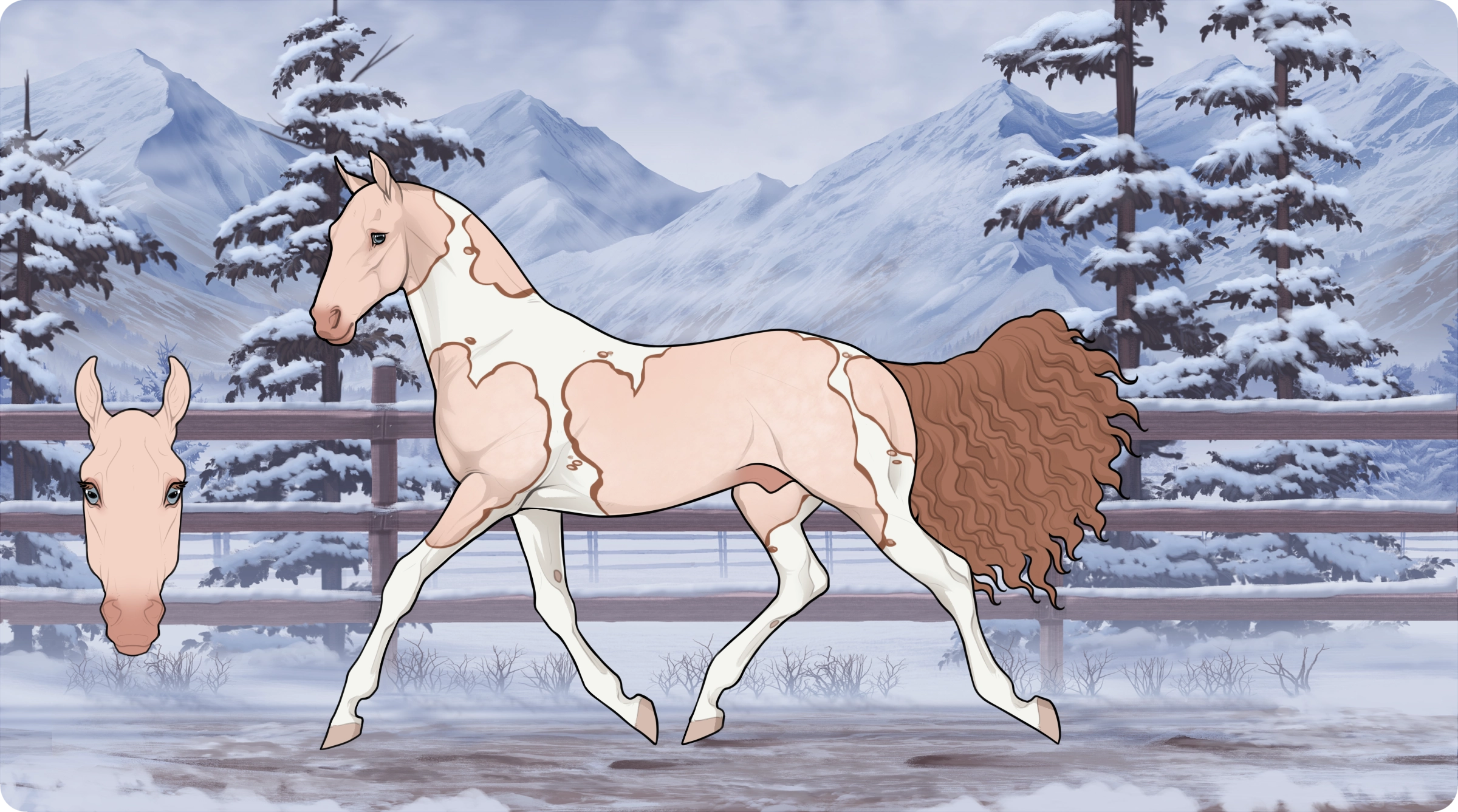
Perlino Tobiano (Carries Rapunzel) + Marbled
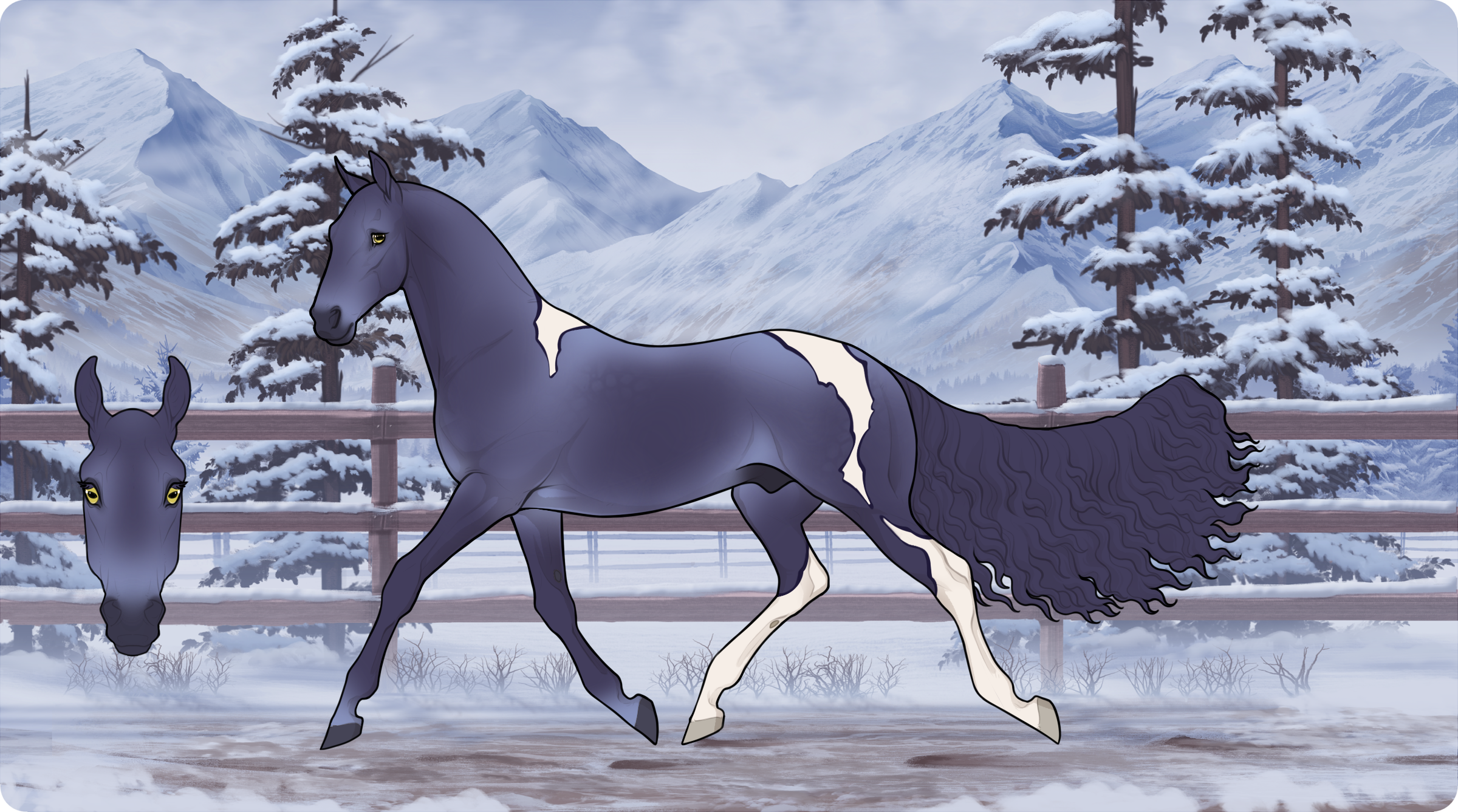
Hyacinth Tobiano Rapunzel + Marbled
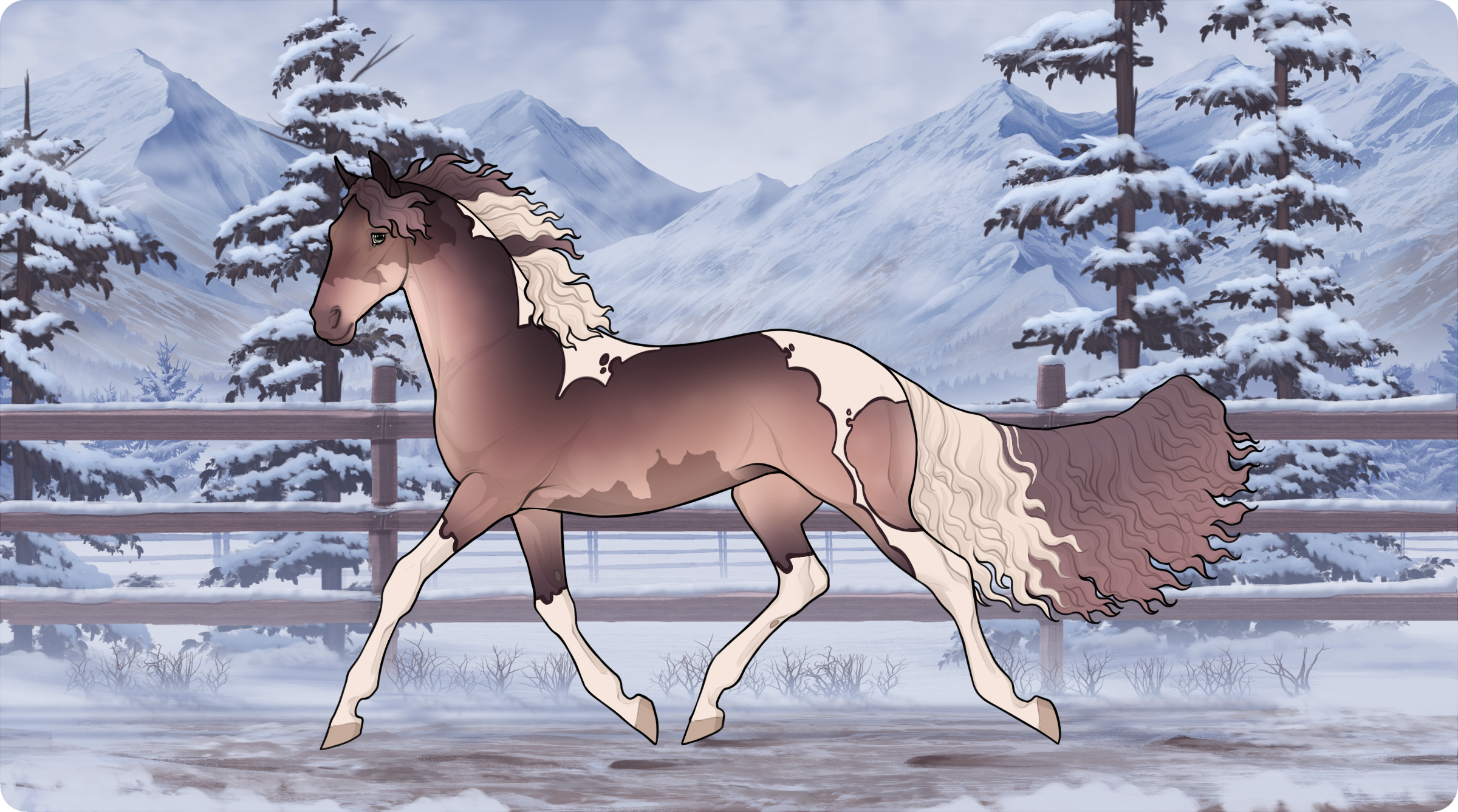
Stained Sooty Pangare Cypress Tobiano Rapunzel + Marbled, Wulf
Capensis (Uncommon)
Overview:
- Lightened marking that presents on the muzzle, over the eye, and optionally along the centerline of each side of the body.
- Each section should be clearly tapered/sharp. The longer a section is, the wider it should be in the middle.
- Markings should always flow in the following ways/directions:
- Muzzle - tapers between nostril and mouth, pointing toward inner eye corner.
- Eye - follows the top of the eye (should not wrap around underside), tapering out toward the neck.
- Neck/Body - follows the flow of the body, curving especially noticeably on the shoulder and hindquarters.
- Mane/Tail: No effect
- Skin:
- Muzzle skin is tinted pink. On dark skin, it becomes a desaturated dark pink, only slightly lighter than the skin below it. On skin that is already pink, it becomes a slightly lighter shade of pink.
- Eye skin is unaffected by Capensis, and will remain the same color as the base already causes.
- Eyes: Causes orange or gold (may have slight peachy hue).
Range:
- Minimum:
- Muzzle marking that crosses between the nostrils and under the chin. Taper should reach at least halfway between nostril and eye. Muzzle spots are optional, but may be present.
- Eye marking that lines the top of the eye, big enough to be clearly visible with a slight "wing" at the outer corner.
- Maximum:
- Muzzle marking that crosses just over the top of the nostrils and covers the entire chin. May connect to eye marking.
- Eye marking covers everything but the underside, tapering out to the edge of the jaw.
- Stripe that follows the center of the body, broken into at least two segments, but no more than four.
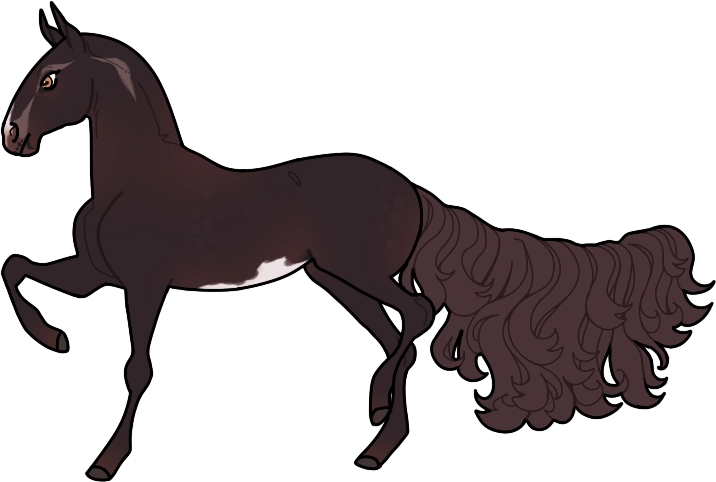
Black Pearl Plum Sabino Rapunzel + Capensis
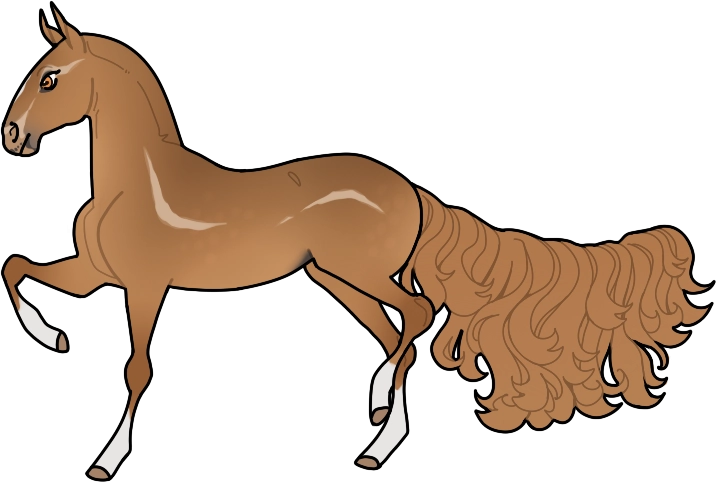
Ginger Rapunzel + Capensis
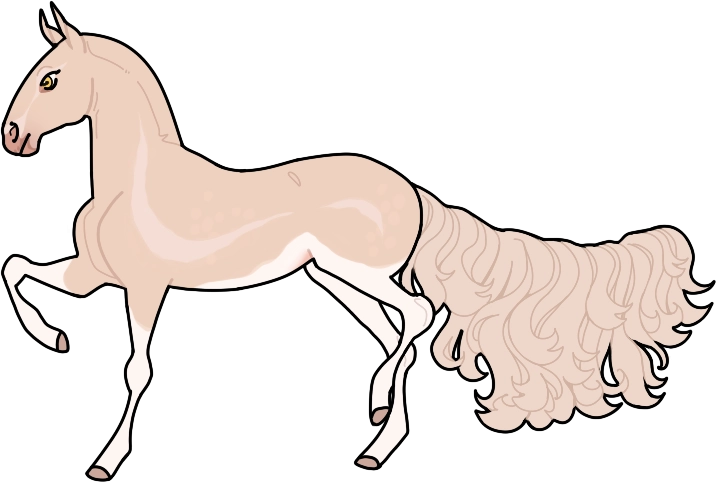
Cremello Splash Rapunzel + Capensis