Design Guide
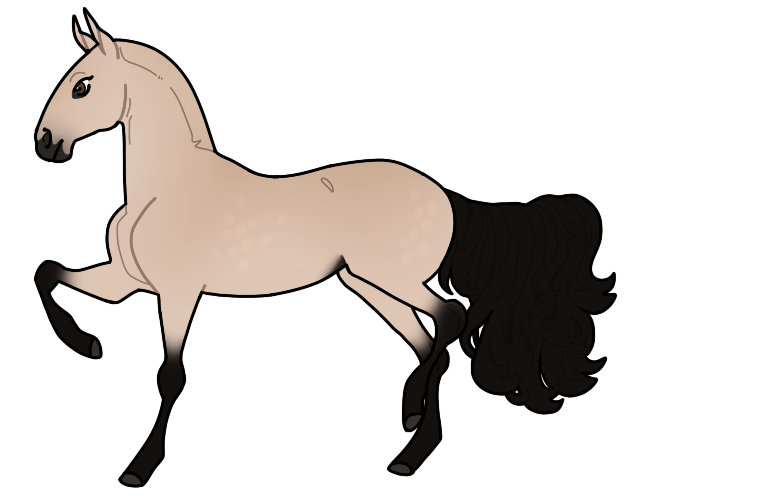
Champagne (Uncommon)

GOLD CHAMPAGNE
- Genetics: ee __ Ch_
- Skin: Pink or Grey-Pink, may have darker freckling
- Eyes: Green/Hazel | Detail Guide
- Coat is light cream/gold, even in tone across the body. Similar to Palomino, but with lighter skin and eyes.
- Mane and tail is pale cream or white.

AMBER CHAMPAGNE
- Genetics: E_ A_ Ch_
- Skin: Pink or Grey-Pink, may have darker freckling
- Eyes: Green/Hazel | Detail Guide
- Body is diluted to a brownish-cream, almost peach color.
- Legs and mane/tail are a darker brown color, again with a slightly peachy tint.

CLASSIC CHAMPAGNE
- Genetics: E_ aa Ch_
- Skin: Pink or Grey-Pink, may have darker freckling
- Eyes: Green/Hazel | Detail Guide
- Coat is a desaturated greyish-brown. Should not be too desaturated, nor be too brown/red. May have a very slight purple hue.
- Legs and mane/tail should be a few shades darker than the body.
Single Cream (Uncommon)

PALOMINO
- Genetics: ee __ nCr
- Skin: Medium/Dark Grey
- Eyes: Brown | Detail Guide
- Body should fall within a cream/gold range, and not overly saturated.
- Mane and tail should be very light cream or white.
- Does not have dark points on the legs.
- When Dun is added, the Phenotype is changed to "Dunalino" instead of "Palomino Dun".
- Variation - Isabella Palomino: Body becomes pale cream instead of darker gold. Skin should remain in normal range. Mane/tail always lighter than body.
- Variation - Chocolate Palomino: Turns the coat chocolatey-brown with lighter blending in the "soft spots." Mane/tail should not be darkened; same as normal.


BUCKSKIN
- Genetics: E_ A_ nCr
- Skin: Dark Grey
- Eyes: Brown | Detail Guide
- Body should fall within a cream/gold range, and not overly saturated.
- Mane and tail should be black.
- Legs should be black to cover the knee/hock, blended where they meet the rest of the coat.
- When Dun is added, the Phenotype is changed to "Dunskin" instead of "Buckskin Dun".
- Variation - Buttermilk Buckskin: Lightens the body to a pale cream shade. Does not dilute the mane/tail or legs.

SMOKY BLACK
- Genetics: E_ aa nCr
- Skin: Dark Grey; matches coat when coat is non-faded
- Eyes: Brown | Detail Guide
- Smoky Black presents in the same manner as normal Black, due to single cream having no impact on black pigment. It can still be faded, however, and many in the HARPG community choose to lean toward this lighter presentation to set it apart.
- Comes in a variety of exact shades, but should overall read as "black" at a glance.
- Coat can be slightly brown/red or even blue/purple in hue, depending on shade and fading.
- Mane/tail should match the coat color. No visible dark points on the legs.
Dun (Uncommon)
Genetics: D_
Locus: B | Ty | Cv | Dt | D
CvD = Dun Civet, TyD = Dun Tabby, BD = Dun Bengal, DtD = Primitive Dun, nD/DD = Dun
Overview:
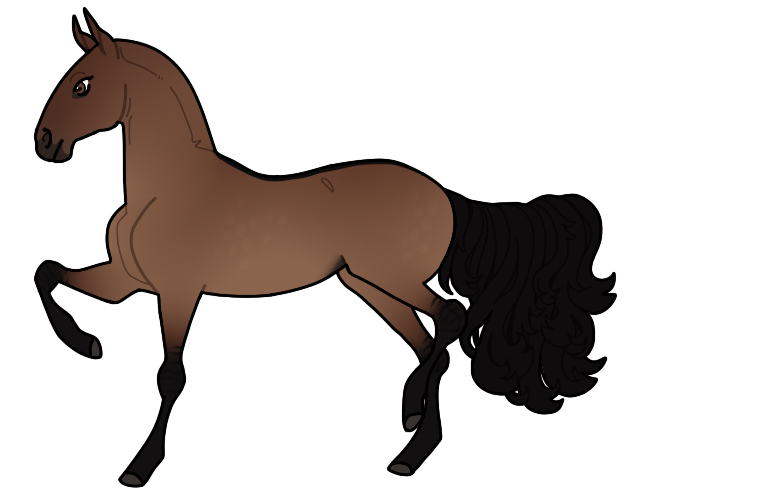
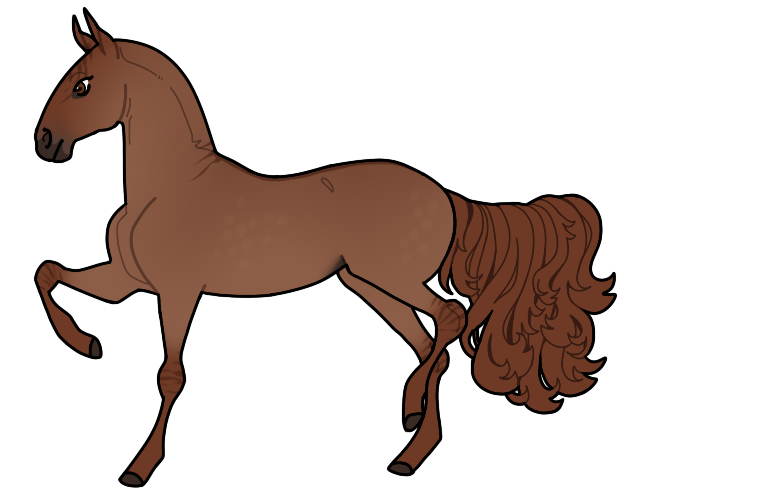
- Dilutes the body, leaving the legs and head alone (may reach the cheek slightly).
- Leg barring should be located on the knee/hock joint, directly above it, or both. It should not reach higher than halfway between the joint and the belly line at maximum.
- Dorsal stripe should be visible from withers to dock of tail. It should not continue up the neck, but may have minor shoulder barring on the withers.
- Primitive markings should be a few shades darker than the points, or black if points are already black.
- Mane/Tail: May exhibit "frosting" at the roots (light guard hairs; blended).
- Skin: No effect
- Eyes: No effect
Interactions:
- Dun Tabby: When Dun and Tabby are present on the same horse, both will co-exist.
- Causes body dilution under the Tabby markings.
- Also causes dorsal stripe and leg barring, but not shoulder barring.
- Dorsal stripe will be on top if darker than Tabby, or underneath if lighter.
- Leg barring should show one or the other on the joint, not overlap.
- Facial cobwebbing from Dun is optional but should not cross/overlap Tabby face markings
- Dun Civet: When Dun and Civet are present on the same horse, both will co-exist.
- Causes body dilution under the Civet markings.
- Dorsal stripe and leg barring are not visible as Civet is on top.
- Should not have shoulder barring from Dun.
- Dun Bengal: When Dun and Bengal are present on the same horse, both will co-exist.
- Causes body dilution under the Bengal markings.
- Also causes dorsal stripe and leg barring, but not shoulder barring.
- Facial cobwebbing from Dun is optional but should not cross/overlap Bengal face markings.
- Dorsal stripe will be underneath Bengal markings.
- Roan: Roan may lighten the presentation of Dun but not fully mask the primitive markings.
- Pangare: Pangare may lighten the presentation of Dun but not fully mask the primitive markings.
Range:
- Minimum: Dilution (lightening) of the body, as well as leg barring and dorsal stripe.
- Maximum: Dilution (lightening) of the body, as well as leg barring and dorsal stripe. Shoulder barring and facial "cobwebbing" that radiates from the forehead.
Bay Dun

Spice Dun
Red Dun
Roan (Uncommon)
Genetics: R_
Locus: Rm | R
RmR = Merle Roan, nR/RR = Roan
Overview:
- Lightens the body, leaving the head and legs alone.
- Edges should be clearly blended, often most sharp when reaching maximum.
- Ranges in the amount of lightening, from subtle to near-white depending on base.
- Optional features:
- May show "corn spots", small spots/nicks in the roan that expose the base color beneath.
- May show "reverse dappling", dapples that are darker than what's below them.
- Mane/Tail: May have light blending at the roots.
- Skin: No effect
- Eyes: No effect
Interactions:
- Blotted: Blotted may affect Roan.
- Dun: Roan may lighten the presentation of Dun but not fully mask the primitive markings.
- Sooty: Sooty may darken Roan slightly but not fully mask it; lightening must still be obvious.
Range:
- Minimum: Should clearly originate from the top of the butt and blend outward. Visible lightening at least to the withers horizontally. and at least to the belly line vertically.
- Maximum: Lightening up to the edge of the jaw/ears, and just above the knees/hocks.

Red Roan

Blue Roan (with corn spots)

Blue Roan
Tobiano (Uncommon)
Genetics: T_
Locus: T
Overview:
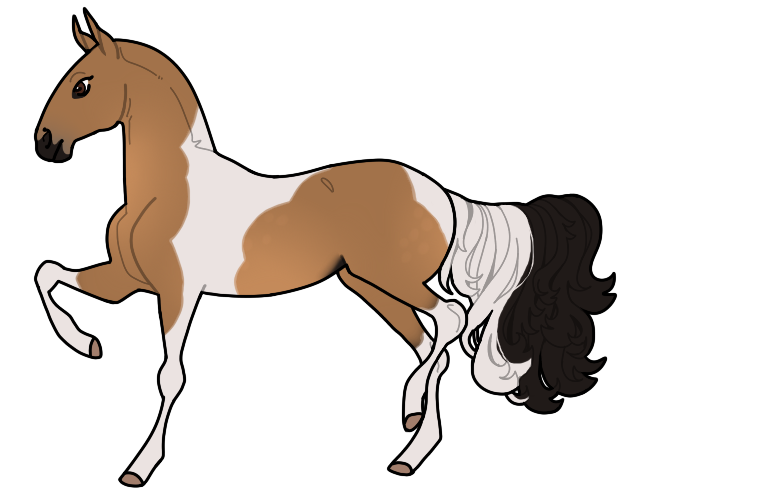
- White marking that extends down from the topline, often beginning at withers and croup.
- Should be fairly smooth at the edges, with large "cutouts" that give smooth curves.
- White markings may have "cat tracks" within them (holes/spots, typically close to edges).
- Does not cause face white outside of natural white bounds.
- Mane/Tail:
- Mane solid white where marking is touching.
- If white touching tail, will be fully white, partial white (vertical), or blended white roots.
- If white not touching tail, will be fully normal color or blended white roots.
- Skin: Pink skin beneath white markings.
- Eyes: No effect
Range:
- Minimum: Socks on at least two legs (at least halfway between pastern and knee/hock).
- Maximum: Color must be present on the head, chest, and groin/flank area. White elsewhere.
Buckskin Tobiano

Chestnut Tobiano
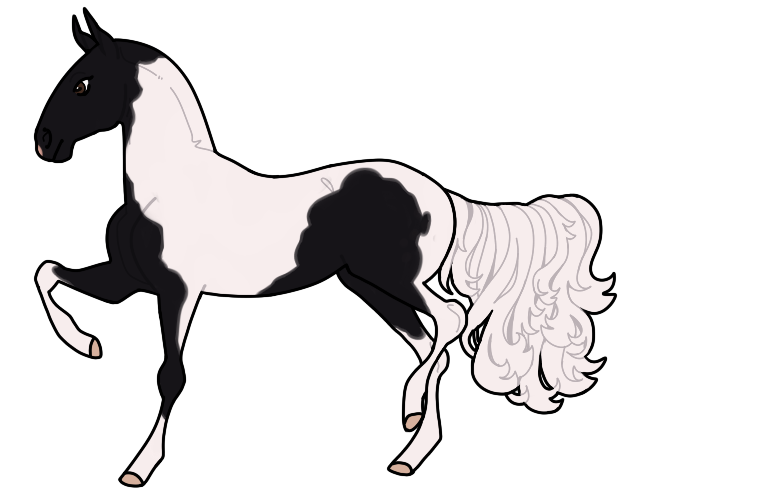
Black Tobiano
Splash (Uncommon)
Genetics: Spl_
Locus: Spl
Overview:
- White comes from the underside of the horse, as if dipped in white paint.
- Can start at the belly without touching the legs, but must be connected to the underside of the horse rather than being free-floating.
- Should follow a fairly smooth line along the marking path, but may have some edge irregularity.
- Can cause extensive white on the face, but should again be relatively smooth.
- Mane/Tail:
- Mane solid white where touching
- If white touching tail, will be fully white
- If white not touching tail, will be fully normal color, or white hair at the tips
- Skin: Pink skin beneath white markings.
- Eyes: Blue (optional)
Range:
- Minimum: May be hidden.
- Maximum: Should have visible, somewhat thick color on at least half of the topline from forehead to tail.
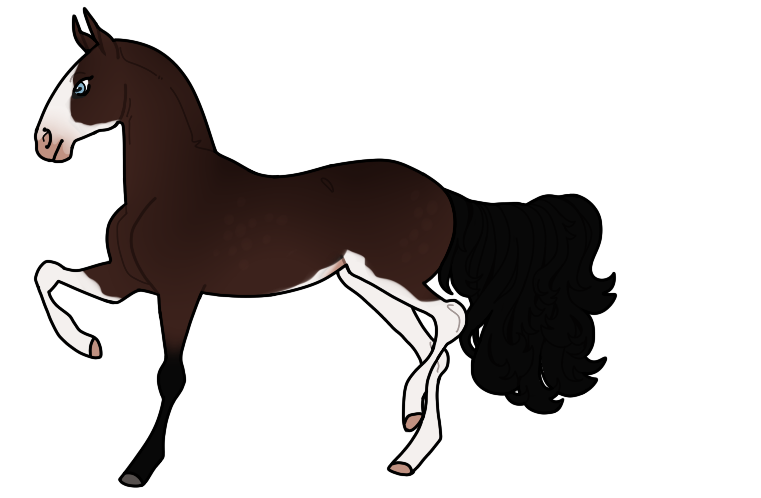
Bay Splash
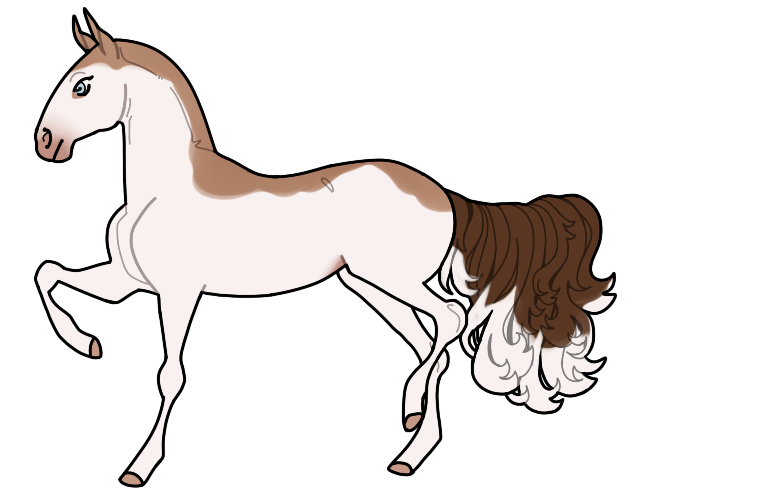
Amber Champagne Splash
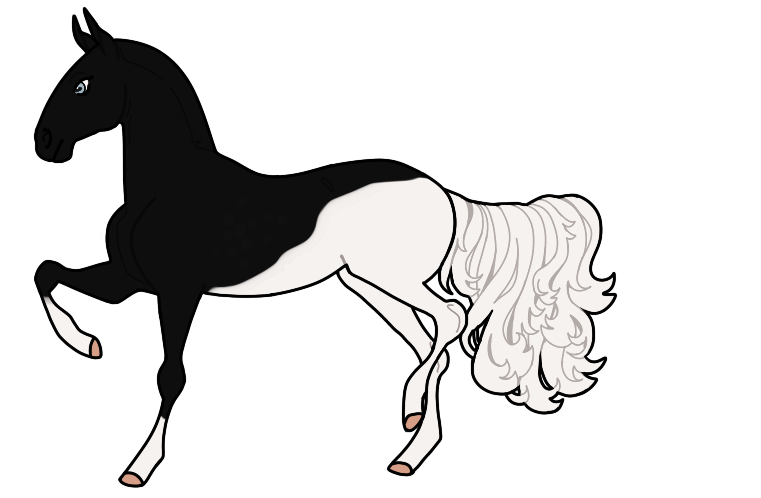
Black Splash
Snowflake Appaloosa (Uncommon)
Genetics: nLp
Locus: Lp | Modified by patn
nLp = Snowflake Appaloosa, nLp patn = Blanket Appaloosa, nLp patnpatn = Leopard Appaloosa
LpLp patn = Snowcap Appaloosa, LpLp = Varnish Roan, LpLp patnpatn = Fewspot Appaloosa
Overview:
- Causes a dispersion of white spots across the body.
- Can range in size, but will typically be around eye to hoof sized, with some being slightly larger or smaller.
- Must cover significant amount of the body, and not be too few as to suggest Birdcatcher Spots, nor too dense as to suggest Snowfall.
- Tends to focus on the body/neck/head, and should be very sparse on the legs if present there at all.
- Mane/Tail: No effect
- Skin: Pink skin beneath white markings, optional pink mottling on unaffected skin.
- Hooves: Optional tan/shell striping.
- Eyes: No effect
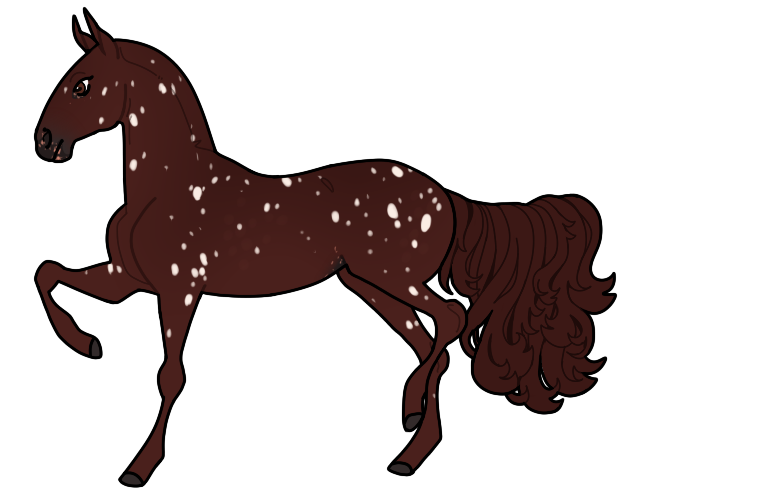
Chestnut Snowflake Appaloosa
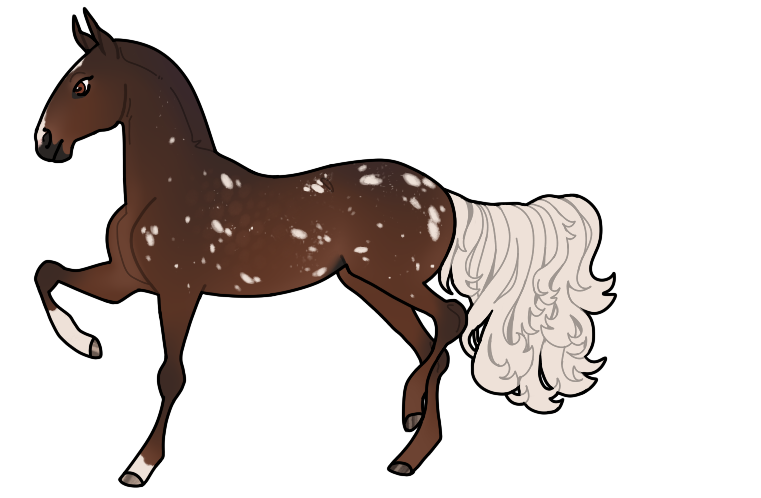
Flaxen Sooty Chestnut Snowflake Appaloosa

Amber Champagne Dun Snowflake Appaloosa
Blanket Appaloosa (Uncommon)
Genetics: nLp patn
Locus: Lp | Modified by patn
nLp = Snowflake Appaloosa, nLp patn = Blanket Appaloosa, nLp patnpatn = Leopard Appaloosa
LpLp patn = Snowcap Appaloosa, LpLp = Varnish Roan, LpLp patnpatn = Fewspot Appaloosa
Overview:
- Causes a white "blanket" starting at the rump, with an assortment of oval-shaped holes/spots that reveal the base color beneath.
- Spots can range in size, but will typically have the majority be around eye to hoof sized, with some slightly smaller or larger.
- May have small dark spots scattered within the blanket and slightly outside of it, and may have white spots scattered slightly outside it.
- Blanket must have a defined edge rather than fully blended out (this is also applicable to Semi-Leopard). Varnishing underneath/around the blanket, however, may be more blended.
- Mane/Tail: No effect
- Skin: Pink skin beneath white markings, optional pink mottling on unaffected skin.
- Hooves: Optional tan/shell striping.
- Eyes: No effect
Variations:
- Semi-Leopard: Categorized by an extensive spotted blanket that goes beyond the withers, extending up the neck. Tends to leave the head, chest, and front legs alone or varnished. Should not fully cover the body like Leopard; must clearly still originate from a blanket.
- Peacock [not listed in pheno]: Characterized by white "halos" around the spots in the varnish layer. Must have varnish, not just random white rings.
Range:
- Minimum: Should cover horizontally from dock of tail to point of hip. Should cover at least the top third of the butt vertically.
- Maximum: To still be considered normal Blanket, should not go past the end of the withers. For Semi-Leopard maximum, may cover the topline from poll to dock, but should leave the head, chest, and front legs alone or varnished.

Blue Roan Blanket Appaloosa

Raspberry Semi-Leopard Appaloosa

Seal Bay Blanket Appaloosa (with Peacock spotting)
Snowcap Appaloosa (Uncommon)
Genetics: LpLp patn
Locus: Lp | Modified by patn
nLp = Snowflake Appaloosa, nLp patn = Blanket Appaloosa, nLp patnpatn = Leopard Appaloosa
LpLp patn = Snowcap Appaloosa, LpLp = Varnish Roan, LpLp patnpatn = Fewspot Appaloosa
Overview:
- Causes a solid white "blanket" starting at the rump.
- Blanket edges will have cutout shapes, and may have some small spots at the edge.
- A few small, sparse holes may be present in the Snowcap marking, but not large/numerous enough to suggest Blanket.
- Mane/Tail: No effect
- Skin: Pink skin beneath white markings, optional pink mottling on dark skin.
- Hooves: Optional tan/shell striping
- Eyes: No effect
Range:
- Minimum: Should cover horizontally from dock of tail to point of hip. Should cover at least the top third of the butt vertically.
- Maximum: Should not go past the end of the withers horizontally, and should stop above the hocks vertically.

Seal Bay Snowcap Appaloosa

Silver Dunskin Snowcap Appaloosa

Silver Bay Plum Snowcap Appaloosa + Wulf
Orchid (Uncommon)
Genetics: Or_
Locus: Or
Overview:
- Causes the skin to be pink, even on base colors where this is not usually the case.
- Depending on coat shade, skin will range from light pink to a more blended darker pink.
- May slightly dilute the coat toward warmer, peachy shades. Especially true of particularly dark/cool coats like black, blue roan, etc.
- Dilution effect should be kept fairly minimal and lean toward brown/warm tones, not simply tint the horse pink!
- Mane/Tail: No effect
- Skin: Pink
- Eyes: Pink

Dominant White on Grey on Chestnut Orchid

Grey on Chestnut Orchid (Carries Silver)

Buttermilk Buckskin Orchid
Merle Roan (Uncommon)
Genetics: Rm_
Locus: Cw | Rm | R
CwRm = Cowspot, RmR = Merle Roan, nRm/RmRm = Merle Roan
Overview:
- Originally thought to be an odd type of corn spots, this mutated form of Roan presents similarly to Merle in dogs.
- Causes a "double layer" of roaning with patches that cut through one or both layers, being either the base color, half-opacity, or both.
- Most patches should be close to the size of the head, with some bigger or smaller.
- Edges should either be rounded/cut inward, like Overo, or rounded outward (small rounded edges, not large blobs).
- Patches must be substantial in amount and scattered across the body, not focused on just one area.
- Roaning may extend on to the cheek/head, and any patches there should cut all the way through rather than at half-opacity.
- Mane/Tail: No effect
- Skin: No effect
- Eyes: No effect
Interactions:
- May interact with Blotted.
Range:
- Minimum: Numerous patches at least along the top 2/3 of the body from poll to dock.
- Maximum: Numerous patches on the entire body, including the head (except for bridge of nose/muzzle) but excluding the legs.

Sooty Slate Tuxedo Merle Roan
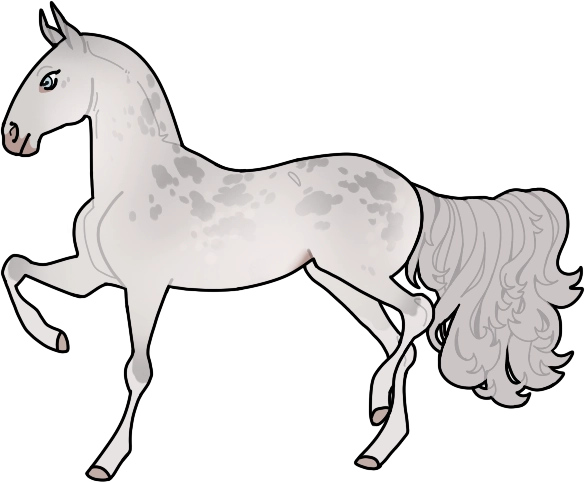
Lilac Merle Roan Splash
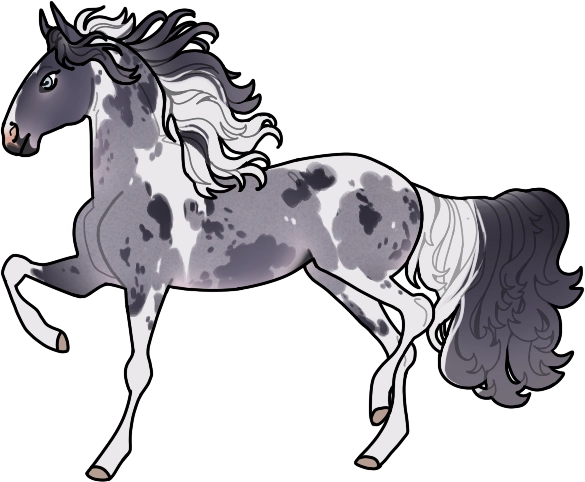
Pangare Onyx Merle Roan Tobiano + Wulf, Birdcatcher Spots
Okapi (Uncommon)
Genetics: Ok_
Locus: Ok
Overview:
- Inspired by real-life Okapis, this mutation can add black and white markings to the head, legs, and hindquarters.
- The following guidelines apply to each area, with the hindquarters/back legs being required, and the other two areas optional.
- Back legs (required):
- Back legs are white to cover the hocks. "Cut-outs" may be present on the hocks or pasterns (may connect); base color or darker.
- White stripes start above the hock, extending all the way up to the tail. Should not be long enough to cross the vertical line of the hip.
- Head (optional):
- White mask should cover most of the face, at least covering the eyes and going down to the jaw.
- "Cut-outs" may be present on the face as simple shapes following the shape of the facial features; base color or darker.
- Front legs (optional):
- Front legs are white to cover the knees . "Cut-outs" may be present on the knees or pasterns (may connect); base color or darker.
- White stripes start above the knee, extending all the way up to the belly line. Will not go further up than this.
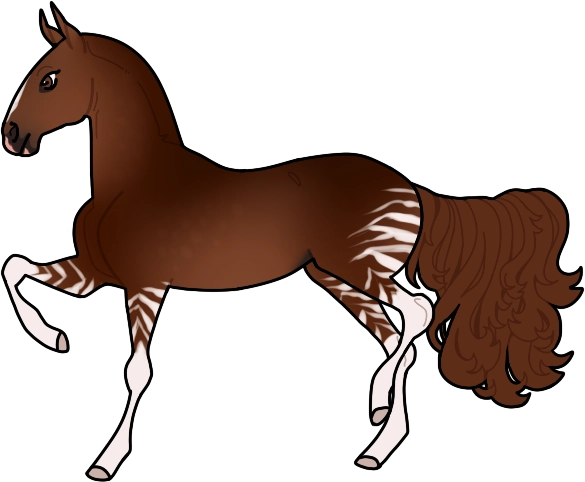
Sooty Chestnut Okapi

Blueberry Okapi + Wulf
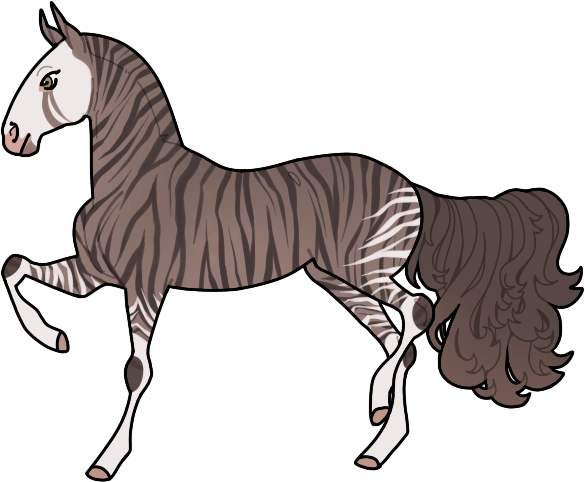
Classic Champagne Bengal Okapi
Hooded (Uncommon)
Genetics: Hd_
Locus: Hd
Overview:
- Inspired by hooded rats, causing extensive white coverage that leaves color only on the head/topline and legs.
- Markings should not be perfectly smooth nor overly jagged; color should be fairly rounded off.
- May have some stray spots or patches of color, but should mostly be connected.
- White must always cover the underside of the horse, including the throat.
- Mane/Tail: White where touching
- Skin: Pink where covering
- Eyes: Optional - Dark Brown | Detail Guide
Range:
- Minimum:
- White markings follow the throat down to the chest. Besides the legs, no color should be present below the horizontal center line of the barrel.
- Color remains on the head and may also be present on the legs, up to a little bit past the knee/hock.
- Maximum:
- White markings extend to the cheek/jaw area, and cover the entirety of the body except for the neck and the rest of the head.
- Unbroken color (if no other patterns are covering) must be present all the way down to the end of the withers, and should be thick enough to be clearly visible.
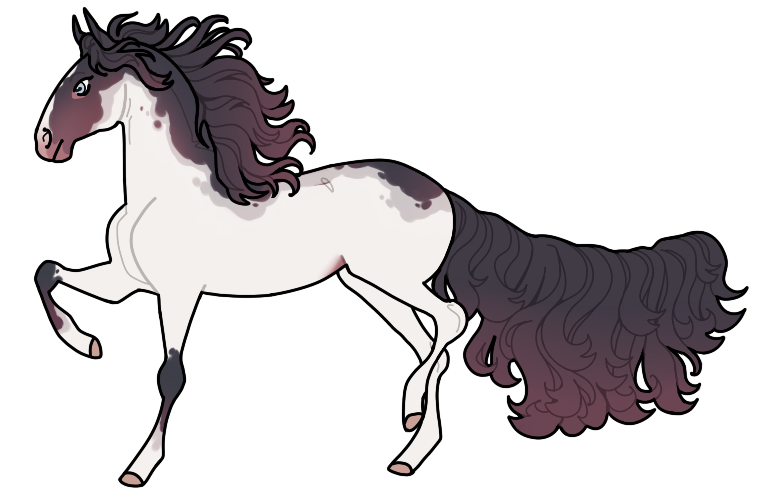 Hooded Poppy Orchid Rapunzel + Wulf, Gemstone, Halo
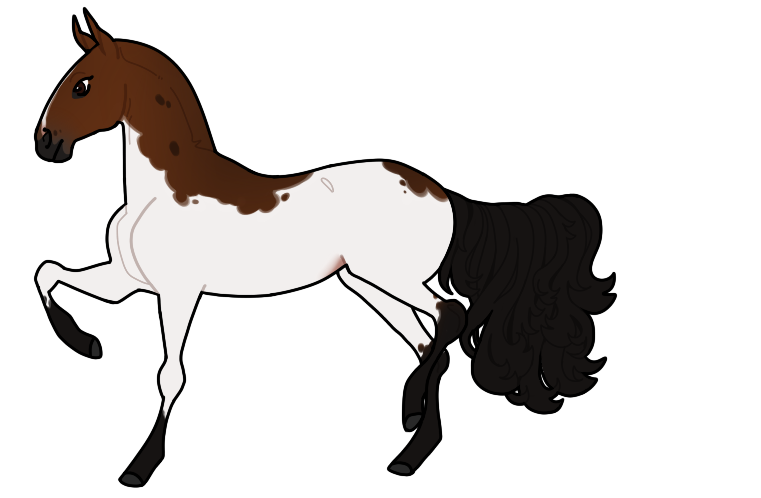 Hooded Bay + Grease Spots
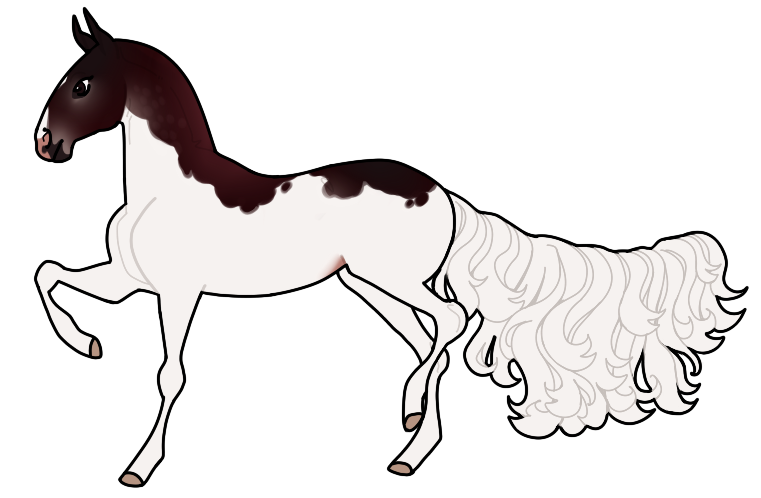 Hooded Grey on Merlot Rapunzel
Bengal (Uncommon)
Genetics: B_
Locus: B | Ty | Cv | Dt | D
BCv = Bengal, BTy = Bengal, BD = Dun Bengal, BDt = Bengal, nB/BB = Bengal
Overview:
- Vertical stripes should cover the entirety of the neck and body, becoming horizontal on the legs and stopping at the knee/hock.
- Stripes should always be darker than whatever is below them, either in one solid color that is darker than all other points or darkened to follow the body gradients.
- Stripes should vary in thickness, have tapered ends, and should not be perfectly straight nor overly wavy. They should follow the flow/curves of the body, striping vertically from topline to underside. Stripes may merge but not cross.
- If present on the face (optional), stripes should be smaller and focused around the eye/forehead/cheek area rather than the entire head. Head markings should look fairly cat-like (similar to tiger or tabby face markings), rather than radiating out like Dun cobwebbing.
- May optionally cause subtle/medium lightening beneath the stripes on the underside, inner legs, muzzle, and cheeks.
- May optionally cause a white spot within the stripe pigment color on the back of the ears, similar to false eye markings on real tigers.
- Mane/Tail: Neck stripes may continue into the mane. Tail may be striped, following the direction of the hair.
- Skin: No effect
- Eyes: No effect
Interactions:
- Dun Bengal: When Dun and Bengal are present on the same horse, both will co-exist.
- Causes body dilution under the Bengal markings.
- Also causes dorsal stripe and leg barring, but not shoulder barring.
- Dorsal stripe will be underneath Bengal markings.
- Only applies to normal Dun, not Primitive Dun.
- Primitive Dun, Tabby, and Civet: Does not interact with these genes. Will display as normal Bengal, hiding the other gene.
Range:
- Minimum: Exhibits striping on the entire body, excluding the head.
- Maximum: Exhibits striping on the entire body, including the head.

Ginger Bengal Sabino

Palomino Bengal Splash Rapunzel + Birdcatcher Spots

Silver Buckskin Bengal Splash + Wulf
Ticked (Uncommon)
Genetics: tcktck*
Locus: tck
*Must be tcktck and accompany nD/DD, nDt/DtDt, nB/BB, DtD, BDt, or BD to show; otherwise carried
Overview:
- Ticked is a modifier gene that interacts only with the Dun locus.
- Mane/Tail: No effect
- Skin: No effect
- Eyes: No effect
Interactions:
- Dun:
- Presentation is normal for the most part, but the body (particularly along the topline) exhibits dark ticking.
- Similar to roan, but with a dispersal of darker hairs rather than lighter ones. Should be visually textured, not flat/smooth darkening.
- Primitive Dun:
- Primitive markings follow their normal flow patterns, but are broken up/interrupted.
- May cause some stripes to appear somewhat spotty. Must still be clearly linear, not randomly spotted.
- Bengal:
- Stripes follow their normal flow patterns, but are broken up/interrupted.
- May cause some stripes to appear somewhat spotty. Must still be clearly linear, not randomly spotted.
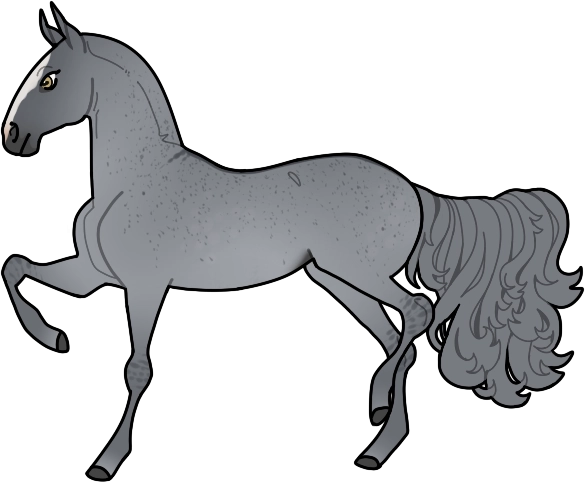
Ticked Slate Dun

Ticked Bay Bengal
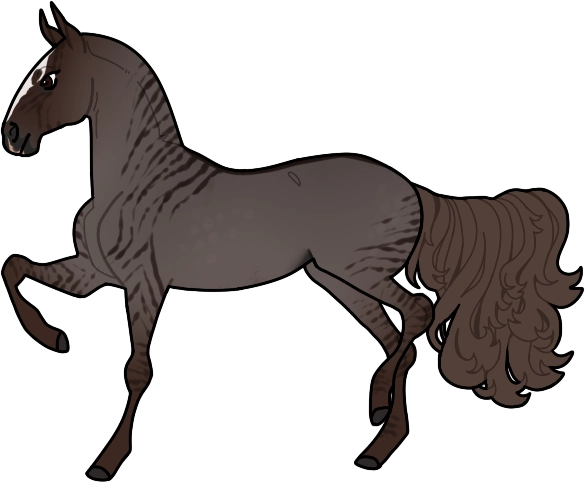
Ticked Primitive Red Dun Roan
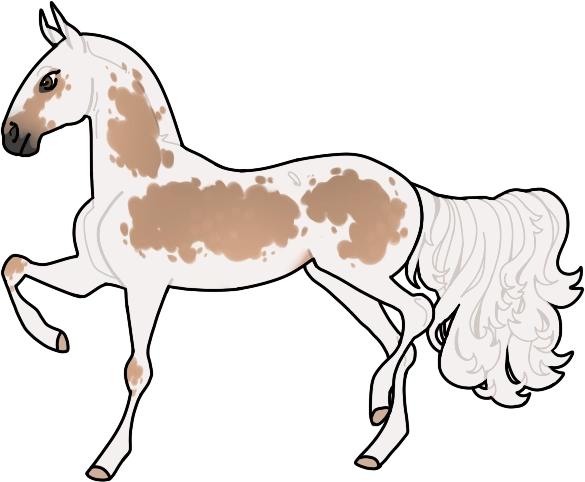
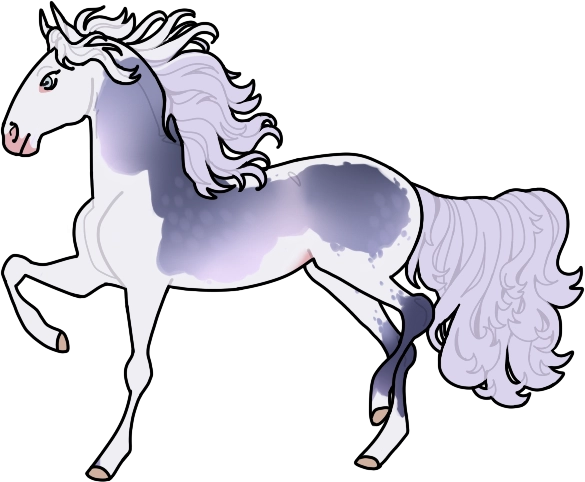
Harlequin (Uncommon)
Genetics: Hq_
Locus: Hq
Overview:
- Causes white markings that push from the outer "frame" of the horse.
- Edges should have rounded cutouts, and will exhibit smaller speckles/spots close to the edge.
- Coverage should be relatively symmetrical on both sides of the horse (not perfect symmetry, just similar amount/areas).
- Top and bottom markings should each be one unbroken marking (or touch/become one), not multiple split up along the area.
- The blue areas in the grey chart below indicate the last areas that Harlequin will fill in; it will begin to "close off" the spaces in between by curving up/down to converge before covering those actual areas. The first and last examples below demonstrate heavier coverage in this manner.

- Mane/Tail: Optional effect; may be white where touching or remain solid.
- Skin: Pink where touching
- Eyes: No effect
Interactions:
- May interact with Patchwork, Inverse, Blotted, Halo, and Stained.
Range:
- Minimum:
- White must cover at least half of the distance from poll to tail, and from throatlatch to buttock.
- Where white crosses the legs, it must at least extend down to a bit below the belly line.
- Maximum: White covers almost the entire body, leaving at least 3 of the head or body areas in the chart below colored. Leg areas optional.
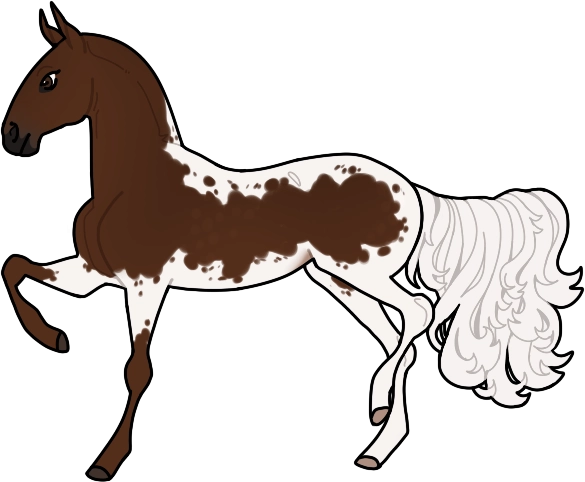
Chestnut Harlequin
Palomino Harlequin
Dusk Harlequin Splash (Carries Rapunzel) + Wulf
Husky (Uncommon)
Genetics: Hk
Locus: Hk | P
HkP = Husky, nHk/HkHk = Husky
Overview:
- Husky is a dramatic lightening pattern that mirrors the appearance of the dog breed that shares its name.
- Lightening should be very pale and visible, sometimes near-white. It should be blended, but should generally be a little sharper than Pangare.
- Lightening must affect the face, neck/throat, chest, armpit, and belly, and may also affect the hindquarters and legs.
- Areas of lightening should follow/hug the curves of the body, coming up highest at the sides of each curved section.
- Face lightening should be a mask centering around the eye and muzzle, often filling in to connect the two and lighten the chin/cheek as well.
- May lighten the brow spot above the eyes as well, as long as the edge is still blended rather than solid.
- May also cause a softly-blended star or stripe marking down the center of the face (example).
- Leg lightening should hug the back side of the legs, leaving the most color on the knee/hock and coronets/pasterns.
- Optional darkening may be present along the topline, similar to Sooty, but this is not a requirement.
- Mane/Tail: Optional; blended lightening from the ends of the hair, up to halfway
- Skin: No effect
- Eyes: Optional; Blue | Detail Guide

Range:
- Minimum: Lightening present on the eyes, muzzle, neck/throat, chest, armpit, and groin.
- Maximum: Lightening present on the face (eyes/muzzle/brows/forehead), muzzle, neck/throat, chest, armpit, groin, legs, and hindquarters. Darkening along the topline. Light gradient from the tips of the hair.

Black Husky
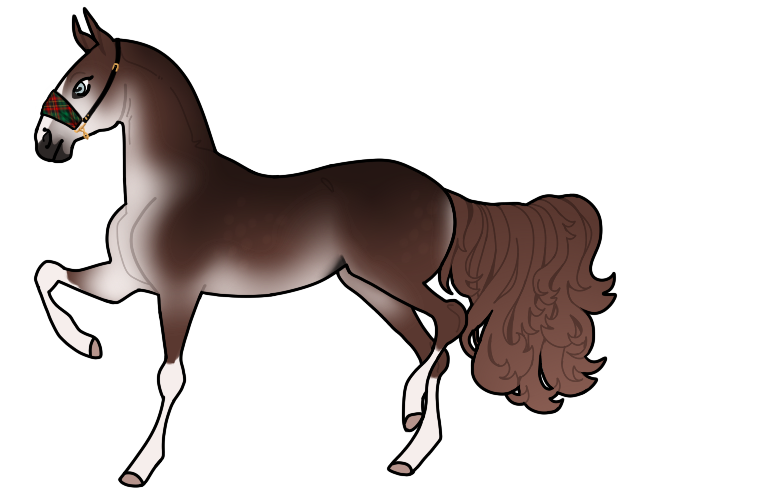
Chestnut Husky Splash

Black Pearl Husky
Fawn (Uncommon)
Genetics: Fwn_
Locus: Fwn
Overview:
- Inspired by fawn markings, this gene causes oval-shaped spots to appear along the topline of the horse.
- Spotting should follow the curve of the body in a linear fashion, arranged in distinct rows instead of randomly interspersed.
- Spots vary in size but will be about the same size on each row, and will get smaller the lower they are on the body. Should not get much bigger than the eye. A few spots may merge/bump into each other, but will not create long lines, and most should stay separate.
- Optionally, pangare-like lightening may cover the belly and a half-heart shaped area on the hindquarters. If those areas are lightened, it may also lighten some or all of these areas - coronets, eyes, muzzle, throat/neck - but cannot do so without the first two.
- Mane/Tail: May slightly lighten up to 1/2 of the tail, starting at tips
- Skin: No effect
- Eyes: No effect
Interactions:
- Spots may be affected by Patchwork, Inverse, and Stained.
Range:
- Minimum: At least two rows of spots, covering either the neck or the hindquarters (hip to dock).
- Maximum:
- Spots cover the whole area from poll to dock, with the largest number of rows on the shoulder and hindquarter areas.
- Neck and barrel should have less rows, so that spots do not extend all the way to the underside.
- Spots should stop at the belly line, not go on to the legs.
- Lightening in the areas described in the Overview.

Buckskin Fawn Rapunzel + Wulf

Sooty Palomino Plum Dun Fawn Tobiano Rapunzel + Gemstone
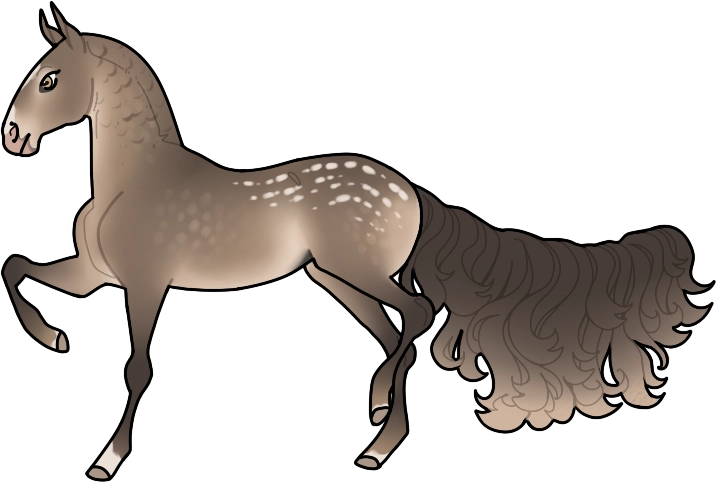
Pangare Spice Fawn Rapunzel + Plumage
Lapin (Uncommon)
⭐ There are three distinct variations of Lapin (see below). Please choose one when designing and edit the phenotype accordingly!
Genetics: Lap_
Locus: Lap
English Lapin
(default - not required to edit pheno unless desired)
Overview:
- White marking that colors most of the horse, leaving the topline, eyes, and muzzle unaffected with optional body spotting.
- Dorsal stripe and markings should not be perfectly smooth; should have slightly rounded cutouts into the white.
- Body spotting should follow the body in a wave/curve, and may start at withers or hocks (can trail off or cover full area).
- Many English Lapin horses display a "beauty spot" beneath the eye, but this is optional.
- Some clustered spotting may also be present at the withers.
- Min/Max is a bit hard to define since the features can be mixed and matched a bit (bigger/smaller muzzle marking, more/less/no spots, etc).
- Mane/Tail:
- Forelock may be white if there is no pigment between the ears.
- Otherwise unaffected (left colored normally).
- Skin: Pink where covering
- Eyes: No effect
Interactions:
- May interact with Patchwork, Inverse, Blotted, Halo, and Stained.
Range:
- Minimum:
- Colored dorsal stripe extends from the poll (between ears) to the dock (start of tail).
- Muzzle is left pigmented, fully covering the nostrils, lips, and chin. Around eye is also left pigmented.
- Spots present from withers to hocks, plus one "beauty spot" under each eye.
- Maximum:
- Colored dorsal stripe extends from just behind the poll (between ears) to the dock (start of tail).
- Muzzle is left pigmented, mostly covering the nostrils, lips, and chin (may end slightly early). Underneath eye is also left pigmented.

Grey on Blueberry Lapin + Rift, Wulf
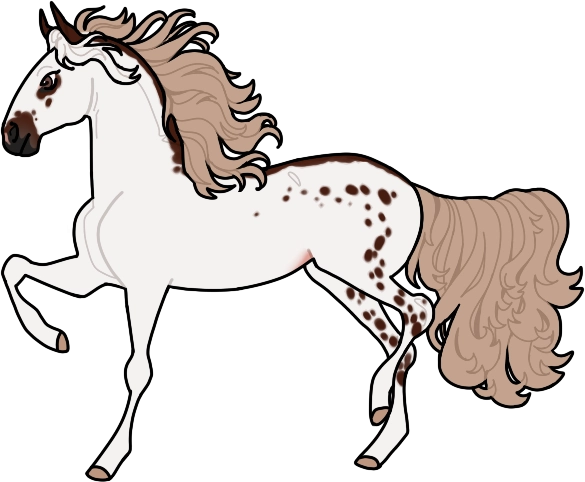
Flaxen Liver Chestnut Lapin + Wulf
Dutch Lapin
(required to edit pheno if chosen)
Overview:
- White marking that covers the neck and shoulder, with optional head markings.
- Face marking originates from a snip on the nose and bleeds up/outward. Cannot have other facial white if this is present.
- Markings should be fairly smooth at the edges, sloped inward rather than bulging outward.
- Mane/Tail:
- Mane solid white where touching
- No effect on tail (does not reach)
- Skin: Pink where covering
- Eyes: No effect
Interactions:
- May interact with Patchwork, Inverse, Blotted, Halo, and Stained.
Range:
- Minimum:
- White at least 2/3 up the neck.
- White from middle of withers to armpit.
- Maximum:
- White all the way up to throat and behind the ears.
- White from end of withers to the same vertical point on the belly.
- Face Marking: Starts at top of forehead and ends at the front edge of the cheek, wrapping in front of the eyes (not covering).

Silver Blueberry Dutch Lapin Rapunzel Orchid + Vitiligo

Sooty Pangare Liver Chestnut Splash Dutch Lapin Rapunzel
Cali Lapin
(required to edit pheno if chosen)
Overview:
- White marking that covers the majority of the body, leaving extreme areas of the face and legs alone.
- May leave the knees/hocks alone, or leave the pasterns alone, but not neither/both/combo.
- Markings should have rounded cutouts into the white rather than being perfectly smooth, but shouldn't be spotty/jagged.
- Mane/Tail:
- Mane may be solid white, normal colored, or have a colored forelock if pigmented between the ears.
- No effect on tail (always left colored normally).
- Skin: Pink where covering
- Eyes: No effect
Interactions:
- May interact with Patchwork, Inverse, Blotted, Halo, and Stained.
Range:
- Minimum:
- Color left on the ears, as well as the poll to bridge the space between them.
- Color on the nose/muzzle, fully encompassing nostrils/lips/chin and spiking upward to the start of the eyes.
- Color on the knees/hocks OR the pasterns (not both, neither, or a combination).
- Maximum:
- Color left on the ears only, but not the poll.
- Color in a snip shape on the nose, at least as large as the nostril.
- Color on the knees/hocks OR the pasterns (not both, neither, or a combination).

Blue Roan Cali Lapin + Chimera (Blue Roan)
Sooty Black Pearl Plum Cali Lapin (Carries Rapunzel) + Gemstone, Rift
Tabby (Uncommon)
Genetics: Ty_
Locus: B | Ty | Cv | Dt | D
BTy = Bengal, TyCv = Tabby, TyDt = Tabby, TyD = Dun Tabby, nTty/TyTy = Tabby
Overview:
- Causes swirl/stripe markings that mirror the appearance of classic tabby cats, causing a combination of swirls around 1-3 origin points on the body and stripes that follow the flow/shape of the body.
- Stripes should generally be oriented horizontally on most of the body, but may become more vertical in the neck/withers area.
- Markings are always darker than what's below them, but can be lowered in opacity as to be affected by natural variance.
- Where they cross the undersides or at the edge of partial-body coverage, stripes may optionally be faded by a soft gradient, either to lower their opacity or fade them out completely.
- Ends of the stripes should taper, and width of stripes should vary. Origin point of the swirled markings may be more solid/rounded.
- Face markings are optional on the cheek/jaw and forehead areas, often with the classic M-shaped mark above the eyes like tabby cats.
- Mane/Tail: Neck stripes may continue into the mane if they cross over the crest. Tail may be striped, following the direction of the hair. Both mane and tail stripes may be solid from root to tip or fade out at the ends.
- Skin: No effect
- Eyes: No effect

Interactions:
- Dun Tabby: When Dun and Tabby are present on the same horse, both will co-exist.
- Causes body dilution under the Tabby markings.
- Also causes dorsal stripe and leg barring, but not shoulder barring.
- Dorsal stripe will be on top if darker than Tabby, or underneath if lighter.
- Leg barring should show one or the other on the joint, not overlap.
- Facial cobwebbing from Dun is optional but should not cross/overlap Tabby face markings.
- Only applies to normal Dun, not Primitive Dun.
Range:
- Minimum: Stripes covering at least half of the main part of the body (excludes head/legs). Must have at least one swirl area.
- Maximum: Stripes covering the entire body, except for the head and lower legs.
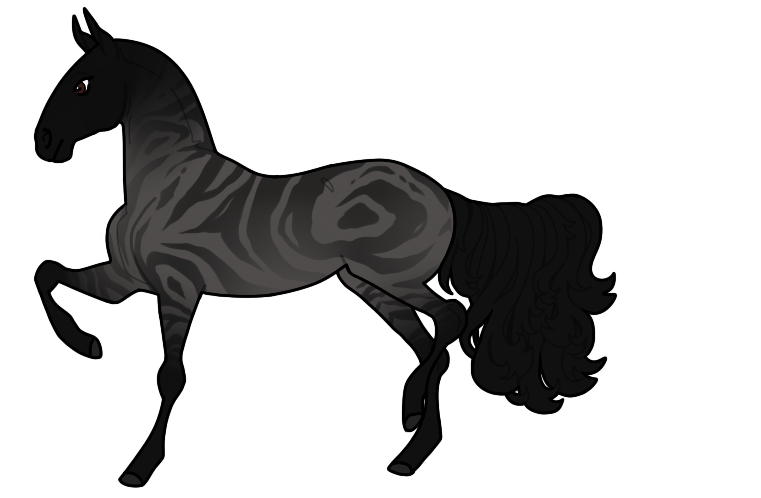
Blue Roan Tabby
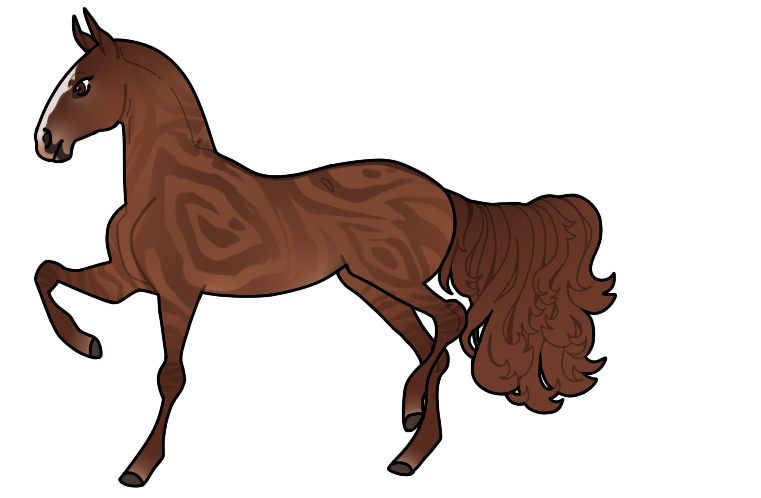
Red Dun Tabby
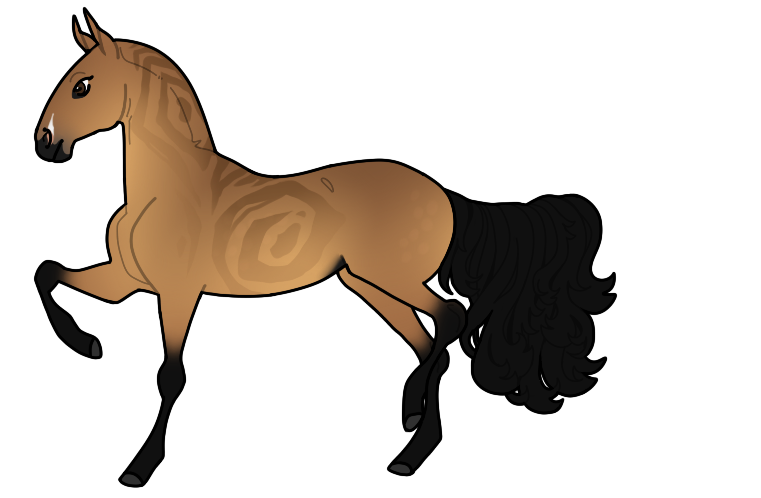
Buckskin Tabby